Welcome to Ultimate Cat—your go-to source for all things feline! From cat care tips and breed guides to quirky behavior insights and adorable stories, this blog celebrates cats in all their whiskered glory. Whether you’re a first-time cat parent or a lifelong feline fanatic, you’ll find helpful info, fun facts, and plenty of purr-worthy content here.
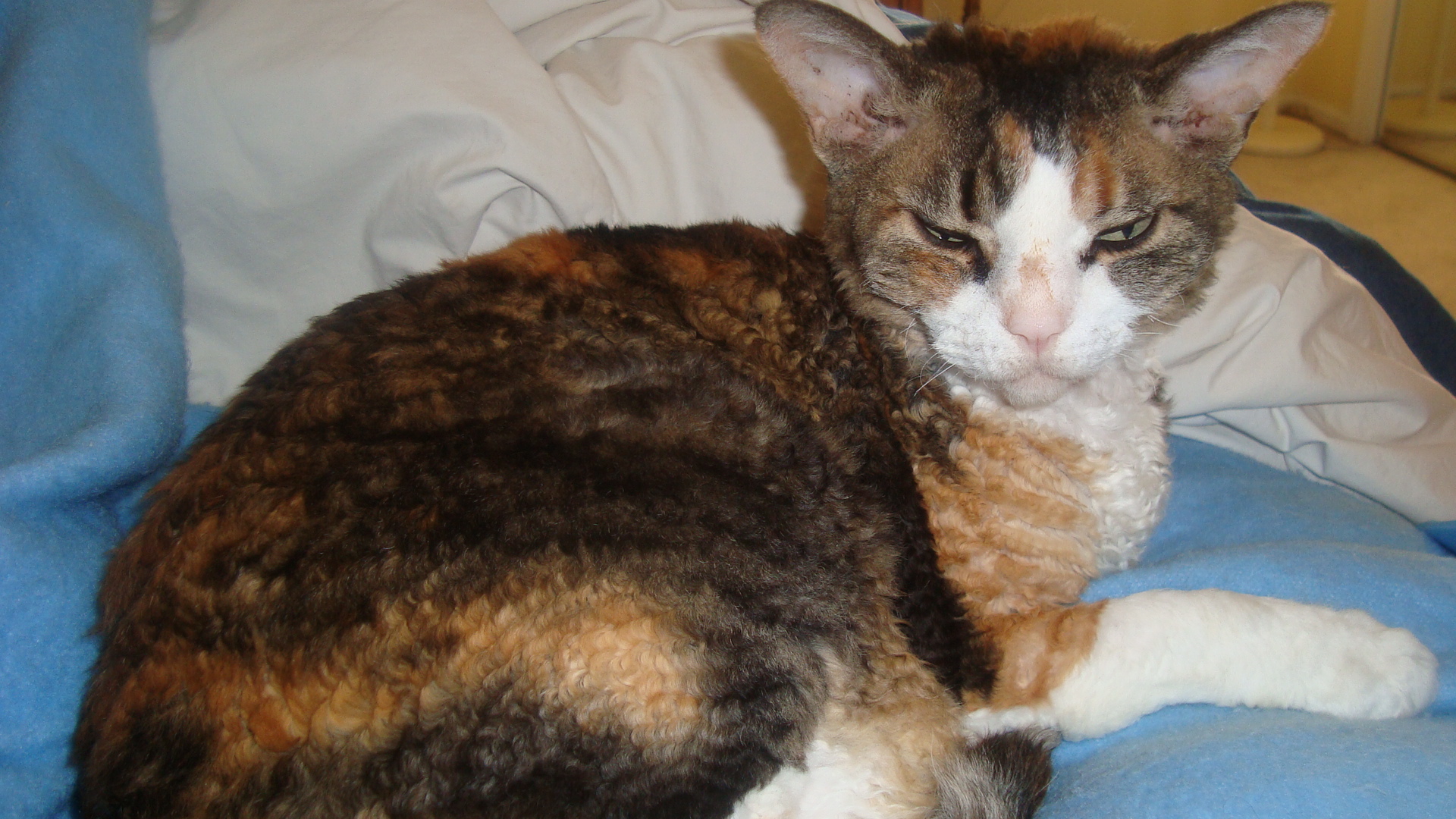
The origin of the Devon Rex cat can be traced to Buckfastleigh, Devon in 1960. There was a feral tom living in an abandoned mine there, one with a curly coat. A woman named Beryl Cox adopted a stray tortie and white female. These two cats inevitably mated, and one of the kittens, a male, had a curly coat just like his father's. This kitten was named Kirlee.
At first it was thought his traits could contribute to the emerging Cornish Rex, but Kirlee's genes were just different enough. Kirlee's whiskers, for example, were stubby, sometimes entirely missing. The Cornish Rex exhibited curled whiskers. Kirlee's hair was tightly curled and not at all uniform. The Cornish Rex had a uniform coat. Kirlee had large eyes, a short nose, and low-set ears. The Cornish Rex did not.
Clearly the genes controlling the two mutations were different. To distinguish them, the Cornish gene was labeled Gene 1 while the Devon gene was labeled Gene 2. Every Devon Rex that has appeared since 1960 carries Gene 2 and can trace its lineage back to Kirlee.
The Appearance of the Devon Rex Cat
At first glance the Devon Rex can seem a little strange. This breed is on the smaller side, generally weighing no more than nine pounds. Like most breeds, females are smaller than males. They are all athletic and have strong muscles. The hind legs are a little longer than the forelegs, giving the cat a slightly lopsided appearance. The ears are huge and the face is shaped like a wedge. In the right light, the Devon Rex almost looks like a rogue pixie. The whiskers and eyebrows of this cat are short and curly, or even missing entirely.
Though the preferred coat is as even as possible and full of loose curls, coats actually vary greatly. Some cats have thick coats, others have sparse coats, and some even have bald patches all over their bodies. This doesn't indicate illness of any kind. It is simply the way Gene 2 expresses itself in different cats.
The coat also changes appearance over the course of the lifetime of each individual cat. Devon Rex cats molt occasionally, causing the coat to break off. They can appear to have a short coat with no curls, or even no coat at all, until the curly coat grows back. Molting is not a fault; it is simply the way these cats are.
When compared to most cats, the body of the Devon Rex is extremely hot to the touch. Some people think this is indicative of illness at first, but it's entirely natural. The coat is so short that it does nothing to keep the body heat next to the body. Because of this trait, these cats get cold easily. They often search for warm places to sleep and can be found stretched out on a radiator or curled up in the sunniest spot in the house.
Grooming the Devon Rex is quite simple since this cat breed doesn't shed much. A quick brush with a grooming mitt once a week is usually all that is required. Because of the short coat, an actual brush is not recommended. The oversized ears can collect grease and dust, so they should be cleaned with a soft cotton ball dipped in baby oil.
The Personality of the Devon Rex Cat
The Devon Rex is playful, intelligent, and loving. This is a highly active breed that likes to climb and run. They have a powerful need to be with people and don't like being left alone. In fact, this cat breed can be destructive when left alone for long periods of time. If you tend to be away for more than four or five hours at a time, a companion cat is a good idea. With a friend, your Devon Rex may be less inclined to destruction and more content to wait for you to arrive home.
This cat is good with children, other pets, and random visitors who might drop in for tea. In fact, the busier your household is, the happier your Devon Rex will be. They love to be the center of attention, so expect your cat to be around whenever there's a crowd. They're not as talkative as the Siamese, but they do make soft chirping sounds if they feel they're being ignored.
Known Health Issues of the Devon Rex
Like many specialty breeds, the Devon Rex suffered from inbreeding in its early years. This has led to some common health problems including coagulopathy (a clotting disorder), luxating patella (slipping kneecaps), and inherited spasticity (spasms). Genetic testing and limited outcrossing are both being used to help reduce the occurrences of these problems.
If you're looking for a cat who has a sweet nature and a slightly different appearance, the Devon Rex might be for you.
Massive change such as a world war often triggers genetic change. This is how the Cornish Rex first developed. On July 21st, 1950, a litter of five kittens was born in Cornwall, England. One of these five kittens was a curly coated, cream male. This kitten was named Kallibunker by his owner, Nina Ennismore. Ennismore assumed that the coat was the result of a spontaneous mutation, the same kind that had been seen in horses, rats, and mice.
Under the advice of geneticist A.C. Jude and cat fancier Brian Stirling-Webb, Ennismore bred Kallibunker back to his mother (a tortie-and-white shorthair named Serena). This breeding produced two males and a female in the later summer of 1952. Both males had the curly coat of their father. One of these died before reaching seven months of age. The other was named Poldhu and is considered the father of the Cornish Rex cat breed, which was named because of its place of origin.
The problem with the foundation stock, including both Kallibunker and Poldhu, was one of a limited gene pool. There just weren`t that many Cornish Rex cats. So Ennismore had to inbreed her cats quite a bit. Knowing this would eventually compromise their health, she began to outcross to ordinary shorthaired cats. Though she might have introduced the gene into any number of breeds, she chosen to stick with shorthairs, mostly because a longhaired Cornish Rex would suffer from constantly matted hair.
After having achieved a cat population of more than forty cats, Ennismore discovered she could not sell enough of her unique cats to stay financially afloat. She chose to put many of her cats to sleep, the aging Kallibunker and Serena among them. She might have still had Poldhu, but two veterinarians performed a testicular biopsy in an attempt to determine if Poldhu was simply a blue-tabby-and-white stud or something more rare, siring blue cream and white. Females of this latter sort were common, but males were rare. Even more rare was a male of this sort who was fertile. Most were born sterile.
Though the vets promised Ennismore that Poldhu`s fertility would not be damaged, he never sired another litter after the biopsy. To make matters worse, the sample extracted from Poldhu was lost somewhere in the laboratory, rendering the entire procedure worthless.
This might have spelled the end of the Cornish Rex if not for Brian Stirling-Webb. In 1962, he learned that a male Rex kitten had been born in Devon. The woman who owned this kitten (named Kirlee) offered him to Stirling-Webb, hoping this would inject new blood into the failing Cornish Rex breed. Stirling-Webb bred Kirlee to the Cornish Rexes, but this resulted in kittens with straight hair. It became obvious that the Kirlee did not share the same mutation as the Cornish Rex cats. Luckily further test matings proved that the German Rex cats, developed independently in Germany, were compatible with the Cornish Rex. This allowed the Cornish Rex to continue in England.
Across the ocean, the Cornish Rex was also beginning to thrive. Before giving up her cats in the 1950s, Ennismore had sent several to American breeders. Most of these breeders were actually Siamese breeders, so they used their Siamese cats to enhance the Cornish Rex. This introduced a triangular head shape, fine bones, large ears, and a look reminiscent of the Greyhound dog. In a sense, they created the look of the Cornish Rex we are now familiar with.
The unique look of this breed was popular with cat fanciers and enthusiasts around the world. slowly gained acceptance around the world as a distinct and separate breed from the Devon Rex, beginning with the Canadian Cat Association and the American Cat Fancier`s Association in 1963. The Cat Fancier`s Association, however, continued to see the two breeds as one, registering both as Cornish Rex, until 1979.
The Appearance of the Cornish Rex Cat The physical appearance of the Cornish Rex is unique and a little disconcerting the first time you see one. They`re tall and slender, a little like the Siamese, and have a dainty appearance. Even so, they are strong and well muscled. The power in their legs allows them to leap to astonishing heights. The body itself flows from head to tail.
The ears are rather large and placed on top of the head. The eyes are oval and have a slight upward slant. This, combined with the triangular head, gives the cat an exotic appearance. The body temperature of the Cornish Rex is also higher than would be considered normal for most cats.
But the thing that defines the Cornish Rex is the coat. The coat is short and curly, with even the whiskers and eyebrows having significant curl. There are no guard hairs at all on this breed of cat, so the Cornish Rex is usually soft to the touch. Because of the lack of guard hairs, the coat doesn`t require much in the way of grooming. The coat may be of any color and pattern.
The Personality of the Cornish Rex Cat
If your looking for a cat that is unreserved, friendly, and intelligent, the Cornish Rex might be for you. These unique cats have an almost fanatical need to be the center of attention. Sometimes called the Velcro cat for its need to near people, the Cornish Rex isn`t as independent as some other breeds. They don`t like to be left alone, so this isn`t a good pet for people who are gone twelve hours a day.
The Cornish Rex is full of energy and loves to play games. This is a cat that will love being taught to fetch and will even roughhouse with children to some extent. As long as they can have positive attention, this cat breed will do almost anything and are the entertainers of the cat world. They tend to be excellent with children and adapt well to most situations.
For all that it loves to communicate, the Cornish Rex isn`t a vocal breed. Instead, this cat will get his message across with body language and friendly antics. They use their tail, ears, and paws to tell their story, so watch your feline friend closely if you choose one of these cats.
Known Health Issues of the Cornish Rex
The Cornish Rex has very few genetic health issues, none of them serious. This is a hardy breed that generally enjoys good health. It should be noted, however, that they do have very short hair and have no guard hairs. This means they`re not suitable for colder climates and generally benefit from a cat sweater. You should also clean the ears and between the toes as these areas tend to get greasy.
Is the Cornish Rex Hypoallergenic?
This question comes up a lot, mostly because there are some dog breeds (Poodles among them) with curly hair that does not shed. These dogs are generally considered hypoallergenic as their coat minimizes the risk of allergic reaction. But a cat is not a dog, even though the thought in the 1950s was that the Cornish Rex would turn out to be hypoallergenic.
The problem is root of allergies. In dogs, it's usually the dander. So if the hair doesn't fall out, there's no dander on the couch to cause a reaction. With cats, however, the reaction is typically to the protein Fel D1 (which dogs don't have). This protein is present in the skin, dander, saliva, and urine of cats, including the Cornish Rex. To state it simply, coat type has no impact on allergies, so the Cornish Rex is not hypoallergenic.
The Cornish Rex may not be considered hypoallergenic, but it's still a wonderful and loving companion. These sweet natured felines make excellent pets for many families around the world.
Some breeds are so new they're only recognized by The International Cat Association (TICA). And some of these are allowed to compete in TICA sanctioned shows, but they cannot earn points or titles yet. So it is with the Chausie (pronounced chow-see). This breed, classified as an advanced new breed by TICA at the time of this writing, is not yet a truly recognized breed, but it is well on its way to becoming one.
Though the idea for this breed has its roots in the late 1960s and early 1970s, it was not until 1995 that the Chausie achieved foundation registry with TICA. This was after jungle cats from south central Asia were crossed with Abyssinians. It was a further six years before the breed was advanced to evaluation status. In 2003, the Chausie was granted advanced new breeds status, where it remains as of this writing. Chausie cats can compete in shows, but not yet earn points or titles.
The Chausie, which can weigh up to 30 pounds, is a large-sized cat with a short, fuzzy coat and ears that are a little larger than normal. There are only three color combinations allowed. These are brown ticked tabby, black grizzled tabby, and solid black. The coat is short enough that it needs very little maintenance, but it will become dull if not brushed regularly. To keep your cat looking its best, brush the coat once a week with a soft brush. This had the added benefit of removing dead hair making your cat more comfortable.
These cats are highly intelligent and easily bored. For this reason, Chausie cats do not do well when left on their own. They prefer human companionship, but a feline friend will do. Just don't leave your pet home alone for hours on end unless you want a very upset kitty indeed.
These cats like to have games to play. They are graceful and agile, and can frequently be found perched on top of drapes or slipping behind a bookshelf. They like activities that allow them to really move, so make sure your cat has plenty of room to run, even if it's just around the kitchen.
Chausies are among the healthiest of cat breeds but they do need a glueten-free diet. Because of this, they can't eat most commercial cat foods. A diet of pure meat is best, so you may have to prepare special meals for your cat if you choose this breed.
If you're looking for an unique and athletic companion, the Chausie may be for you. Though they are not a truly recognized breed yet, they probably will be sometime soon. At this point, they may become easier to find. These little house cougars are energetic, however, so bear this in mind and be sure to keep your feline companion occupied.
Also known as the Chartreuse, the history of the Chartreux is long and varied. Though legends regarding the origins of this silvery-blue breed abound, we'll probably never know how the breed got started. They were shown at a cat show in Paris in 1931 by the Leger sisters. They were and still are rare, and so did not appear in the United States until the 1970s. However, it wasn't until 1987 that the Chartreux was granted championship status by the Cat Fancier's Association (CFA).
The Appearance of the Chartreux Cat
The Chartreux is a fairly large cat as cats go. Its body is muscular, its limbs short, but the paws look almost too large for the body and legs. The head is nicely rounded while the muzzle is long and tapered. The shape of the muzzle makes it appear this cat is smiling, almost like the Cheshire Cat from Alice in Wonderland. The eyes of the Chartreux should be a gleaming gold. Deep copper is also acceptable.
The coat of this rare breed is soft and plush. It should not be bristly or sharp. The hairs are rather short, but the dense undercoat makes it appear longer than it really is. All Chartreux are blue in color with a deep silver sheen. They appear to glow in low light. This cat is relatively low maintenance, but you should use a soft cloth or a grooming glove to remove dead hair once a week. This will keep your feline friend's coat soft and gleaming.
The Personality of the Chartreux Cat
Not a vocal breed, the Chartreux rarely makes any sound at all. They are intelligent, willing to learn, and utterly silent. These qualities combine to make them excellent hunters. They'll wait patiently for prey and have the ability to stay still for long stretches of time. They're rare enough that they are not usually employed at mousers, but when they are, they're excellent at the job.
If you're looking for a cat who loves to play and may even learn to fetch, the Chartreux might be for you. They're always willing to engage in games and hate being left alone. These cats do well with small children and other pets, but they do tend to bond to one specific person. When they do, they rarely leave this person in peace. Even so, they'll remain affectionate and loving toward the rest of the family.
Known Health Issues of the Chartreux
Since breeding programs for the Chartreux are relatively recent, this breed tends to be more robust than many. These cats bred themselves with very little interference for many years, probably longer than we know, so genetic health conditions are rare. Some cats are prone to patellar luxation, also known as slipping kneecaps. Most breeders are away of this and are careful not to breed lines with this particular problem.
The Chartreux is a pleasant and sweet cat and makes a wonderful addition to any household. Bear in mind that they are rare, and so have a higher price tag than some cat breeds. But if you're willing to spend the money, you can find yourself a loving and beautiful feline friend.
The first real record of a Burmese cat dates back to 1930. A cat named Wong Mau was brought over from the orient and gifted to Dr. Joseph Thompson. All modern Burmese can trace their lineage to Wong Mau, who was a young female at the time. She was walnut brown with points which were slightly darker, which led some to assume she was just a darker Siamese. Dr. Thompson, however, began a breeding program in an attempt to reproduce her unique features.
A breeding with a seal point Siamese produced some kittens like Wong Mau and other like the Siamese father. As breeders continued to use Siamese cats in their breeding programs, the only difference between Siamese and Burmese was the color. Recognition was difficult because most associations required three generations of like-to-like breeding.
The breed finally gained wide recognition in the 1950s. By this time, Siamese outcrosses had stopped, but crosses with black American Shorthair became more common. Over time, colors other than the original brown gained acceptance. The Burmese was recognized by The International Cat Association (TICA) in 1979. It was one of the first breeds to be recognized by this association.
The Appearance of the Burmese Cat
The Burmese has a compact and well muscled body and are medium in size. The ears are a little larger than most other breeds. The coat is silky and generally low maintenance, but does require weekly brushing to remove dead hair and keep your cat looking and feeling his best.
The head of the Burmese is triangular in shape and the eyes are large and golden in color. Kittens are born with very distinct points, but as cats age the points become less visible. A full mature cat may appear to be almost solid. There are many colors available, including blue, sable, lilac, chocolate, and even red.
The Personality of the Burmese Cat
If you want a cat who will sit on your lap and never leave you alone, the Burmese may be what you're looking for. These cats like to play and enjoy younger children and small pets as companions. They don't tend to have a problem with dogs, though an older cat with no exposure to canines may be hesitant, especially with large dogs. Like the Siamese, the Burmese is a vocal breed and likes to talk to the people in its family.
The Burmese does not do well on its own. If you're away from home for more than six hours at a time, you might want to consider getting a second cat. This breed is not good for people who are away from home for days at a time, not unless you have someone at home who can keep your cat company.
Known Health Issues of the Burmese
For the most part, the Burmese is a healthy enough cat breed. However, there is a deformity known as the Burmese head fault or craniofacial defect. This deformity is carried on a lethal gene and kittens almost never survive birth. Those that do are typically euthanized to spare them a slow and cruel death.
The good news is that this defect is found exclusively in the American Burmese, and American Burmese are banned from most breeding programs. Ask your local breeder about instances of this defect in their breeding program to determine if your cat is at risk.
The Burmese is a sweet and loving cat who needs attention. This breed is perfect for the family who wants an affectionate loving pet.
Sylvester was an energetic, fun-loving, half Siamese black and white cat. He looked so much like the well-loved cartoon character that his name can naturally. No one really remembered who named the cat, but his young mistress took all the credit.
This particular cat had a bit of an attitude. He had his favorite people, much like anyone, and he had an odd way of showing it. Sylvester took an instant liking to his mistress's Grandmother. The feeling was not mutual, as Grandma was more of a dog person. Still, she treated the young cat well and even brought him treats once in a while. The treats went a long way to making Sylvester love Grandma, and he started to pester her whenever she came over.
Grandma, not wanting to encourage the cat, decided to ignore him. This didn't please Sylvester at all. One day, when Grandma came for a visit, Sylvester decided he'd either get her attention or get even. He didn't much care which. After the obligatory round of hugs and kisses, Grandma took a seat in the kitchen, selecting the chair nearest the refrigerator.
Sylvester immediately hopped on top of the fridge and perched like a hawk. He hovered over her, fixing her with a stare that was nothing short of predatory. This continued for the better part of two hours.
Finally, Grandma couldn't take it anymore. "Stop it." She didn't yell, she didn't scold him, just make her statement firmly. Then she went back to the conversation she'd been having with her daughter and granddaughter.
It had no effect on the precocious cat. He continued to stare, unblinking, trying to unnerve her. Grandma started to shift in her chair as the weight of his gaze came to rest on her shoulders.
"Stop it." This time she looked directly at him.
If a cat could smile, Sylvester (or Vesser, as we called him) did. Instead of listening to her, he shuffled forward until he was almost falling off the fridge.
Eventually, Grandma just couldn't take it anymore. She got up and went to the other side of the table, the side nearest the microwave. The microwave sat on a counter, and above the microwave was a cabinet. There was no more than four inches of space between the microwave and the cabinet.
But four inches was nothing to Vesser. He immediately leaped down from the fridge and hopped onto the counter. He slithered into the space between the cabinet and the microwave, wedging himself in there. He inched forward until he was once again hovering over Grandma. The height might have been less, but he still managed to inspire discomfort on the part of his victim.
It wasn't long before Grandma turned to the hovering cat and cried, "What do you want?"
Vesser flew off the microwave and landed lightly on her lap. He placed his delicate paws on her chest and lifted his head toward her. After staring intently into her eyes for several long moments, Sylvester licked her nose once and cuddled his head under her chin. A few moments passed before Grandma put her arms around the purring feline.
"Is this what he wanted?" she asked incredulously.
The cat's young mistress spoke up. "Of course, Grandma. He just wants you to love him, and to make him the center of the world." The young girl smiled. "He is a cat, after all."
Grandma laughed and held Vesser tightly. "Maybe I am a cat person after all." The cat started to knead her with his white paws. "Imagine that, after all these years."
Mistress, Mom, and Grandma all laughed at each other as the rambunctious cat nibbled Grandma's chin.
The history of the British Shorthair goes back to the days when the Romans first invaded what we now call Great Britain. The Romans brought with them shorthaired cats that were originally imported from Egypt. These cats bred freely until concentrated efforts were made to breed for certain traits. This didn't occur until the end of the 19th century. There was a great interest in the blue color, so most breeders bred what they called British Blues. Some of these breeders introduced Persian blood into the mix.
Breeding of these cats continued until World War I (WWI) when the Governing Council of Cat Fancy declared that only 3rd generation offspring of the British Shorthair/Persian crosses were acceptable. This drastically reduced the cats acceptable in breeding programs and very nearly led to the destruction of the British Shorthair as a cat breed.
Luckily, a few dedicated breeders came together to save their beloved British Shorthairs. They crossed the British Shorthairs they had with domestic shorthairs, Persians, and even Russian Blues. It took a while, but by the 1970s the British Shorthair cat was a strong breed once again.
It was in June of 1979 that the British Shorthair was recognized by The International Cat Association (TICA). The longhaired version of the breed, however, was not recognized until May of 2009.
The Appearance of the British Shorthair
This particular breed is medium in size but has a compact and powerful build. The legs are short but strong and the chest is broad. The tail of the British Shorthair is shorter than most other breeds in addition to being quite thick. The eyes are large and round and can be either copper or gold. The nose of this cat is shortened sort of like a Persian.
The coat of the British Shorthair should be dense and soft, feeling very like a thick pile carpet. The beautiful blue coat is the most common and most desirable in this cat breed, but all other colors are acceptable. The coat doesn't tangle or mat, so this cat requires very little grooming. A quick brush one a week is usually sufficient.
These cats can weight up to eighteen pounds. They are also quite sedentary and prone to gaining weight. You can prevent this by feeding the cat a diet high in protein and talking to your vet about other ways to keep your cat at a healthy weight. Activity can also help, so play with you cat often.
Other than the weight issue, there aren't very many real health problems with this cat. There is a slight medical oddity, but it doesn't affect your cat in any real way. This oddity is the blood type of most British Shorthairs. 40% of all British Shorthairs are blood type B despite this blood type being rare among British moggies (think of a moggie as a mutt, but a cat instead of a dog). It's an oddity, but not an important one.
The Personality of the British Shorthair
British Shorthairs are loyal and affectionate, but they're also aloof. They don't generally like to be carried around and they aren't a natural lap cat. This cat breed can tolerate small children and animals, but they're just as happy to live alone. They don't need a companion cat as many other breeds do. The males tend to be more affectionate while the females are more aloof.
The British Shorthair as a breed makes a good pet for a quieter household. While they can adapt to almost any situation, they prefer a home with quite adults and plenty of space to nap.
The modern Bombay cat came out of a desire for a black cat with eyes as bright as copper pennies. Early efforts at stabilizing these traits were unsuccessful. Success was eventually found in 1965 and the Bombay was granted championship status in 1970 by several associations. From there, the breed continued to spread. Today, it is a common breed among cat fanciers.
The Appearance of the Bombay Cat
A deep, true black is the only acceptable color for the Bombay cat and this breed must have copper-colored eyes (though gold is also acceptable, if less desirable). They're basically like a tiny blank panther. The coat of this cat breed is shiny and bright and needs only a brushing once a week to keep it like this.
Bombays are a medium sized cat with a strong and well muscled body. The head should be round and the eyes should be almost too large for the face. This cat is quick and svelte and fully ready to spring at the slightest provocation.
The Personality of the Bombay Cat
Bombays like to play. They are rather like kittens throughout their entire lives. Inquisitive and easy-going, this breed is one of those likely to meet you at the door when you get home from work. They love to be around people and enjoy a large family. Because they don't do well on their own, you should not leave a Bombay all by itself. If you're away from home all day, you really should consider getting two Bombay cats so they can keep each other company.
This cat gets along with everyone. They are the perfect cat for families with young children and anyone who already has a dog or cat at home. They are adaptable and happy cats and will become a part of any family willing to love them.
Known Health Issues of the Bombay
Because these cats are descended from the Burmese, they share similar health problems. They're carefully bred, but this can sometimes lead to cranial deformities and breathing problems. Bombays are bred for their foreshortened nose, but this can cause wheezing and excessive tearing of the eyes. Not all lines have these problems. Talk to your breeder about health problems in their cats. This will give you an idea of what health problems you might expect.
The Bombay is a fun-loving cat who likes to be with people. If you're looking for a cat who sometimes thinks he's a dog and will sleep on your lap until the sky falls down, you might be looking for a Bombay.
The Birman is a cat breed that is medium-large in size with a round head and a stocky build. The feet have white gloves and the back legs have laces extending halfway up. The coat is long, soft, silky, and pointed, but the thickness of the coat will vary according to the season. The coat will generally be fuller in the cooler months and sleeker in the warmer months. Birman cats come in all pointed colors including blue, lilac, seal, and chocolate. The tail, face, paws, and ears are pointed while the body is typically a cream color.
The ears of this cat breed are very wide. Almost as wide as they are tall, actually. The eyes are round and fairly large. They should also be a bright blue, giving the Birman a wide-eyed majesty. The body should be long and sturdy and the tail should balance this body nicely. The legs must be well-muscled and in proportion to the body. Extremely long or short legs are cause for disqualification in the show ring and cats displaying this problem will not be used in breeding programs.
The coat of the Birman cat is not prone to matting, but it needs frequent care just the same. If you own a Birman, you should brush out the coat two or three times a week to prevent matting and other problems. The ears should also be cleaned and excess hair removed from the canal.
If you're looking for a laid back cat who is good with children, you might be looking for a Birman. These cats also get along with other animals most of the time and can peacefully coexist with dogs given a little time to adjust, and can even grow used to farm animals such as horses and sheep. They can also happily be the only pet in the household. They're not picky. Birman cats tend to spend much of their day sleeping and tend to stay out of the way.
They are, however, affectionate cats. Birmans like to know their family loves them. Like the Siamese, the Birman is talkative, but they like a response. If you ignore them, they'll likely stop talking, so engage your feline friend as often as possible.
This is not a breed you can leave at home for days while you're off socializing. Birman cats need stimulation, activity, and time for play. They like toys, but they like people more. They will become bored with nothing to do, and a bored cat is a destructive cat. When not playing or sleeping, the Birman likes to cuddle, so they make a good lap cat.
As a breed, the Birman tends to be fairly healthy with few genetic disorders. There will occasionally be health problems in specific breeding lines, but your breeder should be aware of these and will be able to explain them to you. Most responsible breeders won't breed lines with significant problems, so true health problems in Birman cats are rare.
As a breed, the Birman is sweet and loving. They make great companions for people of all ages and are a wonderful addition to most families.
Bengals are a result of the desire to have a domestic cat that looks and even behaves like a wild jungle cat. The Bengal as we know it today was actually created by Jean Mill in the late 1970s. Mill, who was living in Covina, California at the time, was hoping to reproduce the spotted pattern, colors, and facial qualities of the Asian Leopard Cat. She inherited eight female cats, who were the products of a cross between the Asian Leopard Cat and domestic shorthairs, from a researcher at the University of California. These eight cats would be the first cats in her breeding program.
Of course, you need males for a successful breeding program. Mill added two male cats to her program. One of these was found at a zoo in Delhi, India and was a feral cat, orange in color with deep brown rosettes. The second came from a shelter in Los Angeles and was a simple brown spotted tabby. Both cats were shorthairs, but that's all they seemed to have in common.
Fast forward ten years (1986, to be exact) and there were more than two hundred Bengals all across the United States. The breed was registered with The International Cat Association (TICA). After several years, once Bengals had exhibited a normal sterility profile and was the same on a cellular level as other domestic cats, the breed became eligible to compete. The first Bengals competed in May of 1991. Since this recognition, outcrosses have not been allowed. What this means is that for a cat to be considered a Bengal, both parents must be full-blooded Bengals.
The Bengal is a standard-size cat ranging from six to fifteen pounds. Males are usually at the larger end of this spectrum, but there are exceptions to this rule. Cats are well muscled and are considered among the most athletic of cats.
The spotted coat of the Bengal may be distinct and recognizable by most cat fanciers, but it's not the only Bengal coat. Spots may be either large or small and may have a two-toned appearance. Another coat pattern accepted by most associations is the marble pattern. This is a swirling pattern that looks either like flowing horizontal lines or random swirls. Some cats even have a slightly iridescent appearance. This is called the glitter effect and is highly prized by breeders. Different associations accept different patterns, but they're really all Bengals.
Bengals come in a wide variety of colors, but the black or brown tabby is the most common. Acceptable colors also include grey, bronze, copper, gold, or even mahogany. All Bengals should have spotting or marbling to some extent. The spots or marbling should be either black or a rich brown.
Snow Bengals and silver Bengals are rare but prized. Snow Bengals carry a recessive pointed gene that causes a cream coat with a pearly shimmer. These cats also have blue eyes. Silver Bengals have a white or grey coat with dark grey patterns. Both are you standard Bengal except that they are exhibiting recessive traits.
The personality of the Bengal can take many new owners by surprise. Bengals are not that far removed from their wild ancestors and can sometimes be nervous and a little unruly. They are not generally recommended for families with young children. They are also inquisitive, active, and easily bored. They need something to do at all times, but don't get two unless you love chaos. Two Bengals cause all kinds of trouble.
Bengals need lots of space to run, jump, and climb. It's not usual to find a Bengal perched on a curtain rod or climbing a doorway. They tend to like water and will swim in a pool or bathtub at any opportunity. They are not a docile cat, but they can be integrated into a family with older children and pets if you are patient and ready for unexpected action.
Health problems can be persistent and annoying for Bengals. They are prone to Irritable Bowel Syndrome which is aggravated by most commercial cat foods. Bengal cats need more protein and less grains in their food, so you'll have to spend a little more money to keep your cat healthy. They also have a problem with water. While Bengal cats are susceptible to micro-organisms found in unchlorinated water, they also don't handle chlorinated water well. The best approach is to give them distilled water to drink. That or boil unchlorinated tap water.
Like the Ocicat and other man-made spotted cats, the Bengal doesn't always breed true for pattern, which is still something breeders are working on. Regardless, they are an adventuresome cat and make a good pet, but only if you're ready for anything. They're certainly not a tame breed.
The history of the Balinese is shrouded in mystery. There are references to a longhaired Siamese (coat length is what separates the Balinese from the Siamese) in 1871 and in 1928 the Cat Fanciers Federation (CFF) has a registration record for a longhaired Siamese. Despite this, real breeding for the Balinese didn't really begin until the 1950s. Longhaired kittens born into Siamese litters were singled out for a specific breeding pattern and the Balinese was truly born.
In the beginning, there were only four accepted colors -- chocolate, blue, seal, and lilac. But other colors weren't far behind and in 1979 red, cream, and tabby patterns were added to the acceptable colors list. It was still some time, however, before any of these colors in combination with white were considered acceptable. Today, most colors and patterns are acceptable by most cat associations around the world.
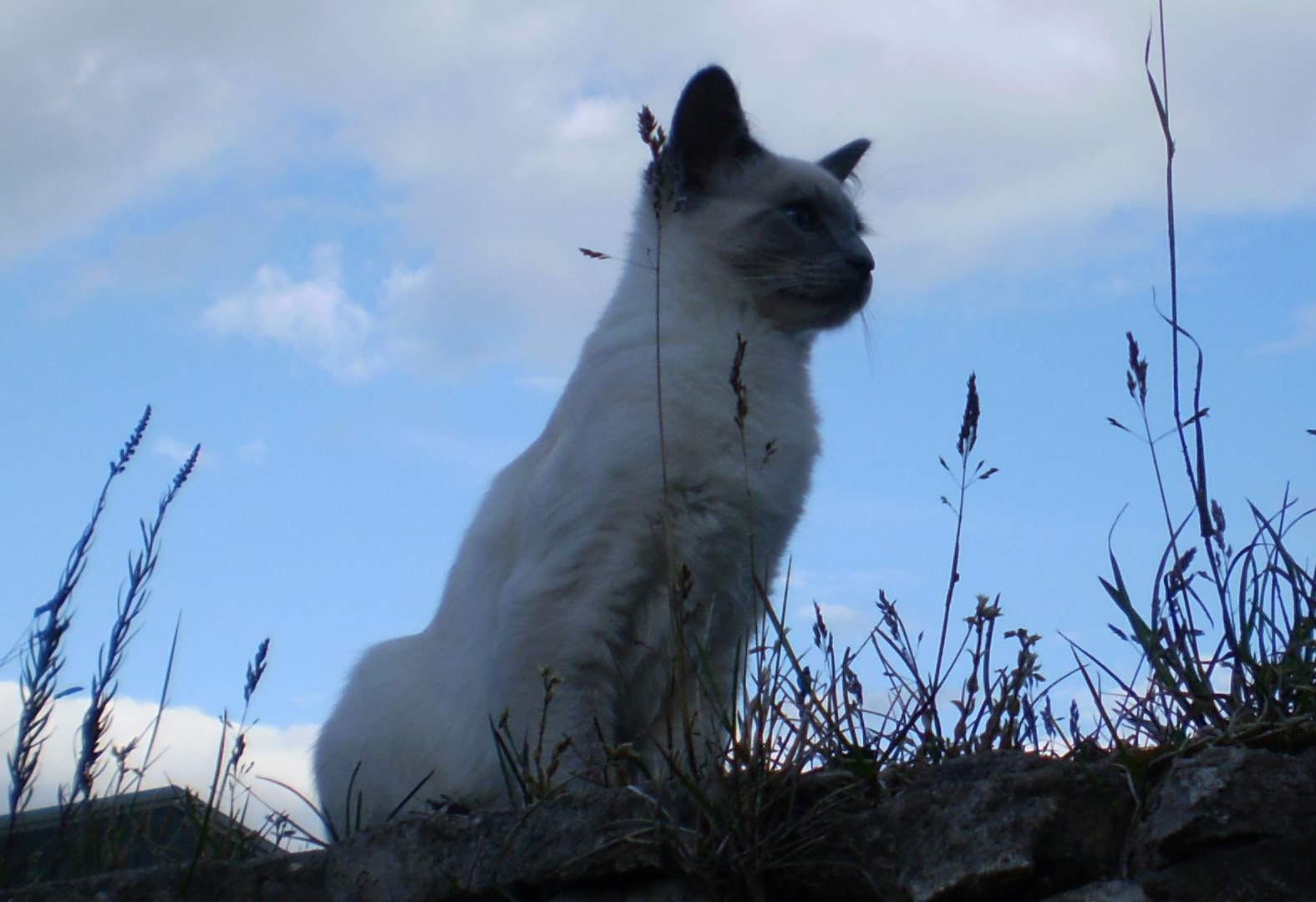
The Balinese is very much like the Siamese except for the longer coat. This longhaired breed is elegant, graceful, and muscular in an understated sort of way. The long coat lies close to the body. There is no undercoat, making grooming easier and limiting the mats that often form with other longhaired breed. The tail is long and plumed with hair that can grow up to 5 inches in length. The body is a creamy white and the markings on the coat should be restricted to the tail, legs, ears, and face.
The eyes of all Balinese should be brilliant blue, very much like glittering sapphires. The legs should be long and the body should be svelte. Some of the larger cats can weigh as much as 8 pounds, though most are closer to 6 pounds. This breed does need some grooming to remove dead hairs and keep the cat comfortable, but the coat doesn't really mat so a weekly brushing is really all that is required.
If you want to understand the personality and temperament of the Balinese, look to the Siamese. A Balinese is one of the most vocal of cats, often having little "conversations" with the people around them. They are also loyal and love to be around people, though they can play the aloof game as well as any other cat breed.
These cats are incredibly intelligent and easily bored, so work to keep your feline companion occupied. They can become destructive is left alone for too long, so if you have to be away from the house for more than 4 or 5 hours, you should probably consider getting a second cat. They need the companionship and they're less likely to dig a hole in your prized couch if they have a friend to occupy their time.
It's important to note that the Javanese is very similar to the Balinese. In fact, since some associations still only recognized the four original colors in the Balinese, other colors are usually assigned to the Javanese. These two breeds are almost identical, however, and many enthusiasts make no distinction between them. Both breeds live for many years and have no breed-specific health issues. They also make excellent companions for people of any age.
Like many breeds, the American Wirehair is the result of what is assumed to be a spontaneous mutation. In the state of New York a litter of 6 kittens were born, one of which had a short, wiry coat and crimped whiskers. This kitten was purchased by a local breeder and bred to 2 different females with normal coats. When the kittens from these crossings all had wiry coats, it was determined that the gene was dominate. Genetic testing confirmed that the hair was unique and unrelated to the stiff coats of either the Devon or the Cornish Rex. And so the American Wirehair was born.
The American Wirehair is very like the American Shorthair in term of conformation, size, and body type. Its body is muscular and firm and its head is longer than it is wide. The eyes are full and round and the ears are slightly rounded at the tip. They are, all in all, a fairly standard cat.
Except for the little thing that makes them unique. The wiry coat is distinctive, but it's not identical on all cats. It can range from spiked (where your cat looks like you've applied gel to spike his fur) to curly, and the individual hairs might be anything from slightly hooked or bent to truly crimped. Regardless of these variations, all American Wirehairs should have a dense and coarse coat, one that is preferably crimped, over the entire body. The whiskers are always crimped. The coat, which comes in virtually all colors and patterns, should spring back into place when disturbed by petting or otherwise being ruffled.
The only real problem with this type of coat is that the cat will be prone to skin ailments. These could include allergies or simply sensitive skin. To reduce these problems, bath the cat at least once a month and groom him daily. These cats also suffer from excess earwax, so clean their ears on a weekly basis.
The American Wirehair is similar in temperament and personality to the American Shorthair. They are friendly with people and like attention, but they are rarely demanding. They are also independent and like to have time alone. They are quick and intelligent and get along well with most people. They are playful and enjoy older children, though they merely tolerate younger children.
This breed of cat makes a loyal and fun companion for many families and individuals. They are also a great conversation starter whenever friends and family meet your feline companion for the first time.
The American Shorthair is often confused with the domestic shorthair, but the two are not the same. The American Shorthair is a recognized breed of cat while the domestic shorthair is the term used to describe a cat with short hair of indeterminate breed. The domestic shorthair is not a breed, but rather a type. The American Shorthair is a distinct breed in its own right.
As a breed, the American Shorthair is a social and amiable creature. They are quiet and affectionate and just generally easygoing. They are suitable for most living situations and thrive both in apartments and out on the farm. These cats purr a lot and they purr loudly, so expect to hear them purring from another room. American Shorthair cats do tend to scratch, so provide a scratching post. These cats like to hunt, so if you have a rodent problem, an American Shorthair can probably help.
This cat breed comes in a variety of colors and patterns. There are currently over eighty recognized designs and colors allowable for the American Shorthair. Color is not as important as conformation and appearance. The ideal cat is entirely symmetrical in both body and coat pattern. Females should be smaller than males and the tail should be slightly shorter than the cat. The tail itself is thick and tapers slowly. The face of an American Shorthair should have an open expression and the eyes should be large, almost round, and of almost any color. Gold or green eyes are preferred, but other colors are also allowed.
The coat of an American Shorthair is, of course, fairly short. It is therefore quite low maintenance, though they do tend to shed. The undercoat is thick, however, so you can keep your cat comfortable by brushing him out twice a week. You can bathe your cat if he gets dirty, but don't do this more than every six weeks or so. More frequent bathing could dry out the skin and cause discomfort and flaking.
All in all, these cats make wonderful friends and companions. They are suitable for just about anyone and are affecte enough to live with children and most other pets.
When choosing a cat breed, especially as a companion animal, you need to consider coat type. The type of coat your coat has will determine how much it sheds and how often you will have to groom your coat.
The hairs on a cat grow from tiny pits in the skin called follicles. Primary hairs, also called guard hairs, are the longest ones in a cat's coat. These grow from individual follicles. These are the hairs that lie on top of the coat and may be either soft of bristly, depending on the breed. These hairs are found on most cats (with the exception of the 'hairless' variety).
Secondary hairs come in two types. Awn hairs are bristly tipped and about medium in length. Down hairs are fine, crinkled, and short in length. All secondary hairs grow in groups from single follicles, making them more likely to tangle and mat.
Grooming needs and shedding are primarily determined by coat type. Cats with a thick undercoats (which consist of secondary hairs) shed more and require more grooming. This is because secondary hair tend to mat and require more attention. So fluffy breeds with a soft undercoat such as the Persian, Himalayan, Balinese, or Birman will require more grooming. These cats have longer hair, but fluffy shorthaired cats shed just as much and need grooming as well.
Cats without the thick undercoat, including the Abyssinian, Siamese, and Oriental Shorthair, will still shed. You really can't avoid it. But they'll drop single hairs instead of large clumps of fuzz. These single hairs are easier to sweep off the couch and don't tend to embed themselves in carpets. These cats don't necessarily require regular grooming, but a quick brush once a week will at least cut down on those pesky hairballs.
Whatever cat you eventually choose, make sure you're aware of their grooming needs. You don't want a cat who's uncomfortable or unhealthy simply because you neglected to do your research.
Just taking a look at the various cat breeds quickly reveals one key difference between many breeds: the length of the coat. Most breeds are shorthaired, such as the American Shorthair, Bombay, Abyssinian, Manx, and so many more. Some are longhaired, such as the Cymric, Persian, and the Ragdoll. Then there are a few of the hairless variety, such as the Cornish Rex and the Sphynx. Coat length is a defining characteristic of many breeds.
In fact, for some breeds coat length is the defining characteristic. The Somali is the Abyssinian with longer hair, but they're not the only breeds separated only by the gene for coat length. In fact, there are six others. These breeds are: the Manx and the Cymric, the Oriental Shorthair and the Oriental Longhair, the Colorpoint Shorthair and the Javanese, the Exotic Shorthair and the Persian, the Scottish Fold and the Scottish Fold Longhair, and the Siamese and the Balinese. Take a look at pictures of the breeds and you'll just how similar they are. If a Somali was born with shorthair, it would pass for an Abyssinian. They're the same cats, just with a different coat length.
Coat length also relegates cats into shorthair or longhair speciality rings at shows, except in the Cat Fanciers' Association where speciality rings are determined by facial type and body conformation. On a practical level, coat length usually determines how much maintence and grooming is required. The Exotic Shorthair will require less grooming than the Persian. It's just a fact. And the hairless breeds require even less.
I talk about hairless breeds now and then, but the term 'hairless' is a bit of a misnomer. Most of the hairless cats are actually covered by a faint peach fuzz, making them shorthaired cats. Still, their hair is so short that if you're classifying cats by coat length, you really should have three categories. I know most associations don't (though there are some that do), but they should. Just my opinion.
So why is coat length important if you're not breeding or showing your cat? Gromming is an issue surely, but so is shedding. Both longhaired and shorthaired cats shed. Only a couple of breeds shed less, but all of them will drop some hair.
When choosing a cat breed as a companion animals, you'll have to consider how much grooming you want to do and how much hair you're willing to put up with. Choose your breed accordingly and save yourself some frustration. There's nothing like the sight of a beautifully-groomed Somali (or insert any longhaired breed here) walking across a sun-lit window sill, but if you're not going to do the grooming, or you're going to hate all the hair, you might want a shorthaired breed.
You might think that size wouldn't be a problem for cat fanciers or breeder. After all, most breeds of domestic cat are fairly uniform in size. Shouldn't this make creating new breeds easier? Doesn't it mean that you can cross breeds and experiement without having to consider size?
The answer to the second quesiton is yes. The answer to the first is, unfortunately, no. Unlike dog breeders, who are able to work with a wide variety of sizes, cat fanciers and breeders are very limited in design. The difference between the largest breed and the smallest breed is barely 12 pounds in weight and less than 1 foot in length. The diffference between the largest and shortest facial profiles is only 2 inches. This isn't a lot to work with in terms of developing new breeds.
This presents a problem for cat breeders that dog breeders simply do not face. If you have only one size to choose from, new breeds, or even variations on a single breed, are difficult to come by. Despite this limitation, breeders have managed to create more than fourty distinctive and recognized breeds. While this may not be as many as dog breeders have been able to create, it is still impressive given the limited variables cat fanciers have to work with.
The eyes are often said to be the windows to the soul, and the eyes of a cat gleam more than most. The romantic notion that a cat's eyes gleam because they house great power or are otherwise mystical in nature is pretty, but there's actually a very scientific explanation for the mysterious luster you found in a cat's eyes.
Cats are the most efficient gleaners of light. Their pupils can dilate to a full half-inch in width or narrow to an almost-invisible slit. Their eyes can take in as much or as little light as they require to effectively see. This trait allows them to see in almost complete darkness. Contrary to popular belief, they cannot see in absolute darkness; Even their sensitive eyes need some light to make sense of the environment. But they can see their surroundings in great detail with only the smallest bit of light.
Cats are not completely color blind, though they can see red only in the emotional sense. By which I mean red is outside their visual abilities. They also can't see orange, since orange is a combination of yellow and red. They can, however, see striking shades of blue, shades we will probably never be able to appreciate.
Felines are also a little farsighted. In fact, their depth of field is in sharpest focus between 7 and 20 feet. This is not to say that they cannot see things outside this field. They can, but they'll see it in sharper detail if it's inside that range.
Like many other breeds, the true origins of the American Curl cat remain a mystery. We do know that a stray kitten was found in California in 1981. This kitten had long silky hair and unique ears. The ears curled backward at the tips. No one really knows where this cat, called Shulamith, came from, but all modern American Curls can be traced back to her.
Shulamith gave birth to her first litter of kittens later that same year and two of the kittens inherited her unique ears. By 1983, breeders had started a breeding program designed to preserve and enhance the mysterious gene that gave these cats their curly ears.
But that may not have been enough to create a new recognized breed if it hadn't been for a man named Roy Robinson. An English feline geneticist of some renown, Robinson analyzed hundreds of kitten from dozens of litters. He determined that the gene for curly ears was an autosomal dominant gene. This meant that a cat with only a single copy of this gene would inherit the curly ears of its parents. But even this may not have been enough to establish the breed if he hadn't conclusively stated that he found no genetic defects in any of the cats he studied. In effect, the American Curl was a new breed, not a mutated or defective version of another breed.
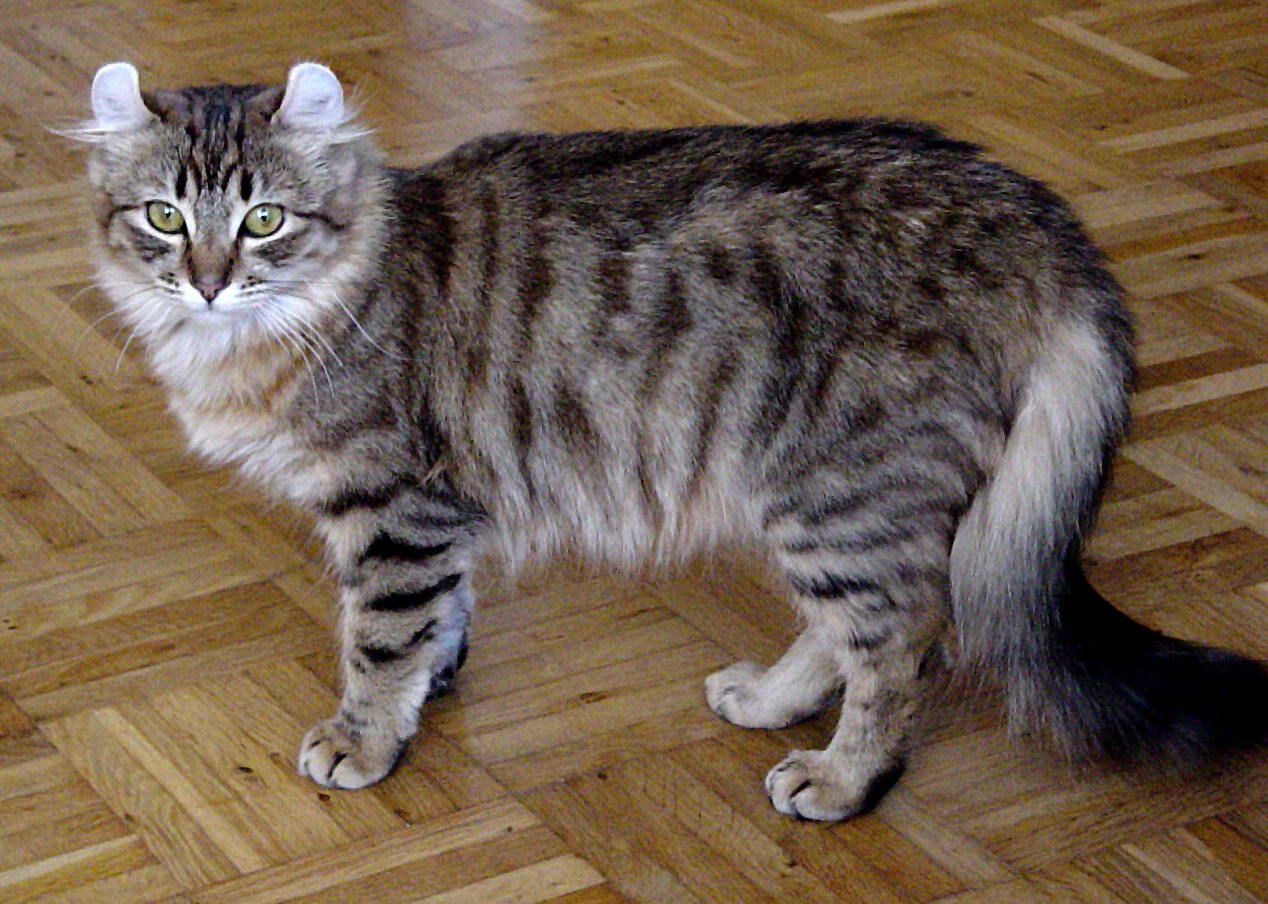
Since Shulamith was found in North American, it's safe to say that the American Curl is native to that continent. American Curls are medium-sized cats with ears that curve up, out, and back. The pull of the ears gives the cat a naturally happy and alert expression. Even when irritated this breed looks like its smiling. The breed may have either long or short hair and may be of many different colors and patterns. You might have a black American Curl or a silver tabby. The defining characteristic is the ears, though the large, almond-shaped eyes are also quite distinctive.
American Curls are not born with curved ears. The ears will begin to curl after about 3-5 days, sometimes a little later. By 16 weeks of age, the ears have reached their final shape. Some cats will have more curl than others.
Because of the limited gene pool (a single cat, Shulamith), other cats without curled ears are bred to American Curls to maintain genetic diversity. Approximately half of these outcrosses will have curled ears and will be used in American Curl breeding programs. This outcrossing makes it difficult to develop a breed standard, which has limited the acceptance of the breed in associations around the world. You might think that a breed such as this would have a few genetic health problems, but American Curls are healthy creatures with a robust constitution.
American Curls are considered one of the friendlier breeds. They like to be with people and tend to follow family members from room to room. They tend to be good with children and adapt well to life with other animals. If you're looking for a vocal cat, the American Curl might not be for you. Instead of loud meows, these cats make soft cooing sounds. These sounds are made by both kittens and cats and full-grown cats act very much like kittens throughout their lives.
This breed is a good pet and companion animal. They are often sought out for their generous and sweet nature and are only rarely purchased as show cats.
The American Bobtail is a fairly recent breed of cat that developed from feral cats that naturally have almost no tail. Back in the 1960s, a young couple (John and Brenda Sanders, to be exact) picked up a kitten along the side of the road while driving in Arizona. This kitten had a shortened tail. When this kitten bred to the non-pedigreed cat the Sanders already had, the kittens had this same shortened tail. Charlotte Bentley and Mindi Shultz, friends of the Sanders, saw this and thought that the kittens might have some potential.
But these kittens weren't actually American Bobtails, which were not recognized around the world until 1989. The first Bobtails were born when the kittens were bred to long-haired pointed cats. Feral cats may have been the foundation stock of the American Bobtail, but they are not used in breeding programs today by reputable breeeders. However, because they are descended from wild cats, American Bobtails have very few health issues to speak of. Ask your breeder for any health problems specific to their breeding program.
The Appearance of the American Bobtail
Obviously the Bobtail has a shortened tail, the appearance of which varies from cat to cat. In fact, kittens in the same litter will have different tail lengths. This is because the genetic mutation which results in the shortened tail is a little wild. There is no way to control it and no way to breed for a specific tail length. Breed standard indicate that the tail much be at least one inch without being longer than the hock, and most American Bobtails fall within this range.
The coat of the Bobtail is either short or long and comes in a wide variety of colors and patterns. Any color is acceptable. It is more the short tail and the well-muscled, solid, graceful, and athletic build of this cat that is judged. But all American Bobtails require regular grooming to stay healthy and presentable. Their fur tangles easily and needs care.
These cats are medium in size with the males ranging from 12 to 16 pounds and the females ranging from 7 to 11 pounds.
The Personality of the American Bobtail
This cats are intelligent and friendly most of the time. They get along well with children and bond to their families in short order. They like attention and hate being left alone, but they're not really the kind of cat the will insist on sitting on your shoulder all day. If you're going to be away, a friend such as a dog or another cat is recommended. They tend to get along well with other animals if introduced slowly, so don't rush introductions.
These cats are neither lazy nor active. They are, in effect, both. When in motion, they're really in motion, dashing about as if being chased by whatever it is they imagine themselves being chased by. But when the American Bobtail decides it's time to laze about, nothing will move them. They're stubborn and will just lay there, often ignoring everything until they're ready to move. Still, they make wonderful and entertaining companions.
A cat's ears have a specific shape that is consistent throughout all breeds of domestic cat. There is a little variation (just look at the ears of a Cornish Rex), but they all stand straight up and form a little triangular cone that naturally faces forward. This is unlike the domestic dog, which varies in ear shape and position (to a certain degree) among the different breeds. The consistency of the shape of the ears provides all cats with the same natural abilities.
The ears of a cat, like the ears of other creatures, receive auditory signals. the upper limit of a cat's hearing is higher than a dog's and almost two full octaves higher than our own. From a distance of at least three feet, cats can discriminate between sources of sound that are as little as three inches apart. This ability is enhanced by the cat's ability to rotate their ears until they are almost pointed backwards. Finding and catching prey becomes easier when you can pinpoint exactly where that mouse is simply by hearing it shift in place, so the ears are a practical tool. The cat's ability to pinpoint and identify sound also lets them ignore the sound of their owners' voices from any distance at all! Any cat owner can sympathize with this.
But the ears can also send signals and are, in fact, one of the primary means of communication for a cat. Think about a cat with its ears flattened back. You know that means kitty is not in a good mood. Relaxed ears mean a relaxed body. Ears which are pricked forward slightly mean alertness. You can tell the mood of your cat simply by looking at the ears regardless of which breed your cat happens to be.
Beyond their practical functions, the ears of a cat are just plain cute. Who can resist the urge to stroke the soft hair that grows on the backs of the ears? And if you scratch the base of the ears, most cats almost fall over in ecstasy. So the ears are decorative as well as functional and are a necessary part of the anatomy of the cat.
It's been months since I posted anything other than articles relating to cat breeds, cat care, and cat anatomy. So I thought I'd mix things up a bit and post a story about a cat I once had when i was a kid. Well, sort of had. Her name was Taffy and she came from a farm not far away from us. She was an excellent mouser, scared off dogs, and was sweet and affectionate with us kids. She also produced a litter of kittens every summer to our delight.
But as she got older, Taffy started to disappear. At first, she'd only be gone for a week or so. Maybe two weeks. But time marched on and she'd be gone for weeks at a time. We'd worry, but she always came back, and always in one piece.
Finally, she wandered into the field one spring just before the snow melted and this time she didn't come back. We watched for her for weeks, but as the snow faded away and the flowers began to bloom, we finally gave up hope. My two sisters and I cried over her, assuming that she'd been killed during her wanderings. Perhaps she'd been hit on the road or eaten by a coyote. Or maybe a cougar as one had been spotted in the area. Whatever had happened to her, we were sure we'd never see her again. So sure that we held a little funeral, as little girls are wont to do, attended by our others cats, our dogs, and our horses. Most of our stuffed animals were there as well. It was a moving and depressing spring afternoon.
Time moved, as it always does, and while we grieved for our lost feline friend, the summer soon washed over us. We found ourselves running in the fields and tearing through the garden without a care in the world. July melted away and August was in full bloom with a heat wave upon us as we had a picnic out in the hay field. The sun beat down as we drank lemonade and caught grasshoppers. The afternoon wore on and we eventually packed our basket so we could head back to the house.
As we gathered up the picnic blankets, a sound floated over the field. At first we thought it was one of the barn cats wandering out into the field to hunt. But my older sister happened to glance over her shoulder and she suddenly turned, focusing on the distant grasses.
"Look," she whispered to no one in particular.
My younger sister and I did, straining to see what she saw. The sound came again and a flash of beige fur caught our attention. We caught our breath as if we were one person. The sound. The flash. I was the first one to speak, though I'm sure we all recognized her.
"Taffy!" I squealed the way only a little girl can.
We all started running toward the cat who was leaping through the field, heading toward us will all possible speed. We abandoned the basket and blankets as we fell to our knees and cuddled her to us, thankful that our little sweetheart was back in our arms. But she was different, and we'd seen her in this state often enough to understand.
"She's pregnant," I stated, running my hands over her swollen belly.
"Not just pregnant," my older sister replied. "She'd having her kittens. Right now."
We didn't waste any more time. My older sister bundled her up in her sweater and we all but ran back to the house. My mother saw us coming and pulled open the door, ushering us into the house while firing questions at my older sister.
"Mom, not now," she replied quickly. "Taffy's having kittens."
"Again?" My mother rolled her eyes as she said this, for Taffy had indeed blessed us with a litter every summer for the past four years.
No one answered as Taffy squirmed in my sister's arms and finally sank her teeth into the exposed flesh of my sister's hand to gain her freedom. Without any hesitation at all, Taffy ran to the back of the house and down the stairs to the basement. We, excited little girls that we were, dashed down the stairs after her.
At the time, all three of us had cute little rooms in the basement. It was an old farmhouse and didn't have central air conditioning, so it was much cooler in the basement during the summer heat waves. Taffy, being familiar with the bedrooms that had been set up only a year before, headed straight to my bedroom. Why my room? Because I had this habit of never pushing the draws shut on my dresser.
Taffy took a flying leap into the first open drawer, the one that held my socks and underwear. She moved around for several minutes and finally settled herself on my cotton panties, fluffing them up and making herself a cozy little nest. Not five minutes later, the first of four kittens squirmed his way into the world.
We'd seen it before, this cat giving birth to anywhere from one to four kittens. But it was still miracle, still made us shut our mouths and watch with wonder. These kittens were larger than normal and had little tuffs of fur on their ears, but they were still sweet little bundles of joy. We smiled as Taffy cleaned them up and revealed their sleek fur.
It would be the last litter of kittens Taffy had at our home. But that's another story ...
Muscles and bone are the very foundation of the conformation of a cat. There are 244 bones in the feline skeleton that lend support and substance to the cat's body. These bones also provide protection for the internal organs. In some breeds of cat the bones are as sturdy as a hardwood such as oak. However, some of the more delicate breeds have bones that are more flimsy and less substantial.
In all breeds the bone is surrounded by muscle. The muscles respond to a series of electrical impulses that are originally issued by the brain. Once these impulses are received, the muscles convert them into contractions using a series of chemical transformations. The muscles produce movement, movement which the bones follow. This movement is usually the gracefulness that defines the cat and its delicate body.