Welcome to Ultimate Cat—your go-to source for all things feline! From cat care tips and breed guides to quirky behavior insights and adorable stories, this blog celebrates cats in all their whiskered glory. Whether you’re a first-time cat parent or a lifelong feline fanatic, you’ll find helpful info, fun facts, and plenty of purr-worthy content here.
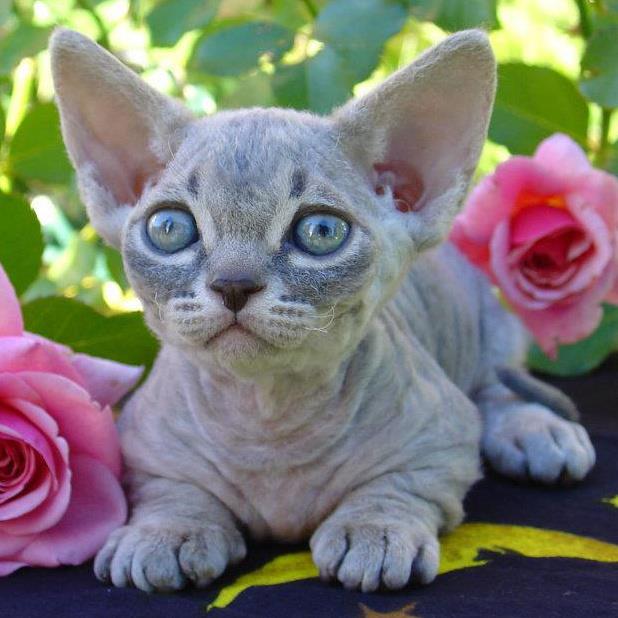
Some breeds come about because a breeder wants a specific look. Such was the case in 1998 when Paul McSorley started crossing a Munchkin with a Sphinx. He wanted a breed that had short legs of a Munchkin but fur that is restricted to the points like a Sphinx. This particular combination took two years to achieve, but finally the first Minskin kitten was born in 2000. Because it is so new, this cat does not yet have Championship status. Instead it is classed as a Preliminary new Breed. This means that it can be shown in TICA shows, but cannot yet earn titles. Whether this young breed will advance is yet to be determined. The Appearance of the Minskin The body of the Minskin, with its short legs and cobby body, is very like the Munchkin in appearance. The head, however, is more Sphinx-like and features the large eyes and large ears so characteristic of the Sphinx. The coat is incredibly sparse and just a little coarse. Because there is so little fur, the fur absorbs the heat from the body, making it feel quite warm to the touch. There is little hair, which means little shedding. This makes grooming a breeze. A quick rub with a chamois cloth once a week usually keeps the cat healthy enough. A soft brush can also be used. The Personality of the Minskin Most Minskins are quite friendly and enjoy the company of humans. They will follow at your feet and climb on your back if given the slightest encouragement. They tend to want to be the sole focus of a human's attention, so they're not that great with other pets. They do love children, however, though care must be taken as this breed is a little more fragile than some others. This is a cat that bores easily, and the Minskin can be destructive when bored. A highly intelligent breed, the Minskin needs something to do. Games and stimulate the mind are a good idea, especially if you're going to be away from home. They don't do well on their own if they don't have something to occupy their busy minds. If you're looking for a cat that's a little unique, the Minskin might be for you. This cat is amusing and entertaining, making him a great companion for the right person.
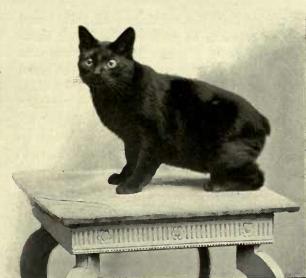
Though some people believe that the Manx cat lost its tail when Noah closed the Ark doors a little too quickly, history tells a different tale. The Manx originated on the Isle of Man, but its ancestors probably arrived by ship from England, Wales, or even Scotland. The genetic mutation that created the unique tail of the Manx occurred on the Isle of Man at least as early as 1810, but there is some evidence to suggest that the tailless cats were running around as early as 1750. We may never really know for sure.
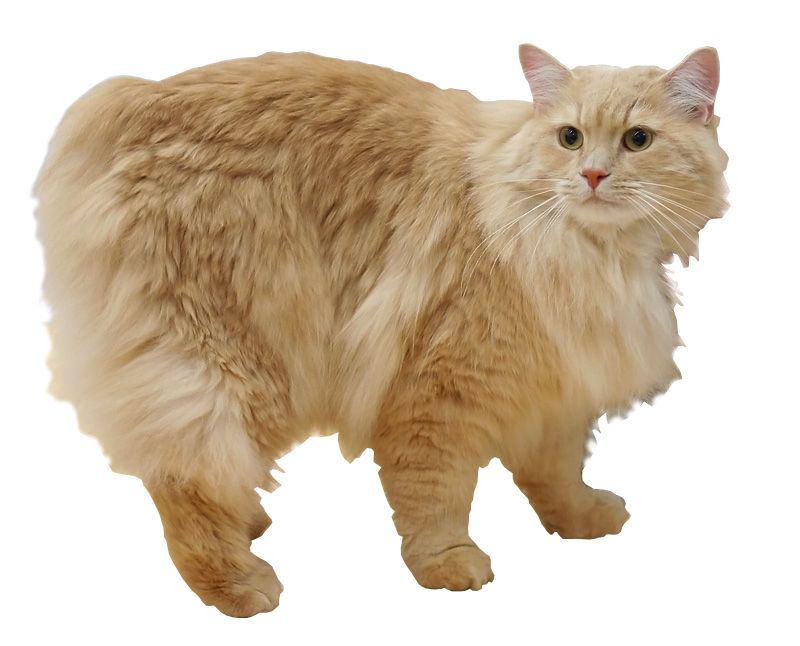
The mutation that caused kittens to be born without the vertebrae of a normal tail is likely the result of inbreeding. The Isle of Man is fairly small, after all, and there were relatively few cats for the breed to develop. In time, some of these tailless cats grew long hair, others remained shorthaired. The shorthaired kittens were labeled Manx, while the longhaired ones received the name of Cymric. The only difference between these two breeds is the length of hair.
The International Cat Association (TICA) recognized both the Manx and the Cymric, granting them championship status, in June of 1979.
The Appearance of the Manx and Cymric
Since the two cats are identical except for coat length, there is little point in describing the same characteristics twice. Both cats are found in all patterns and colors, some more desirable than others. Bold colors and dramatic markings are best, but any color or pattern is acceptable in this versatile breed.
Both versions of this cat have thick coats, giving them a round appearance. The Manx has a short, glossy coat with a glossy appearance. The Cymric should have longer hair that is both silky and plush. A neck ruff and fluffy breeches are required in the longhaired Cymric.
The Cymric and the Manx are both medium in size with a rounded body and head. They resemble furry little bowling bowls and are often referred to as such with great affection. Though they may appear large with their fluffy fur, they are typically no more than 10 pounds.
Despite their reputation for having no tails, these breeds are not all tailless. The tail may be stubby and may even have a slight curl. Even cats with no tails at all have all the nerve endings of a tail, so take care when handling the hindquarters of either breed.
The Personality of the Manx and Cymric
Both the Cymric and the Manx are gentle cats with a sweet and playful disposition. Because these cats are affectionate and quite dependent on people for company, they should not be left alone for long periods. They're not cats you can leave for a week while you go off on vacation, so take this into account.
These cats are not generally great with children and other pets cause of their sensitive tail area. They are amusing for adults, however, and will indulge in a game of fetch if properly enticed. You might even find your Manx or Cymric burying their toys rather like a dog. Neither breed is overly loud, but they will engage you in conversation with a soft thrilling sound if you listen long enough.
If you're looking for a quiet cat who will crave your company, the Manx or the Cymric may be for you. Both breeds require little grooming, just a weekly brushing to keep the coat soft and healthy, so the maintenance are nearly identical.
The origin of the Maine Coon is surrounded by mystery and legend. Though once considered a result of raccoons and cats breeding, we know now that this is not the case. Well, most of us know. There are still some people who believe it, crazy as it might sound. The truth is probably that cats from Europe wandered freely and bred, creating a breed that is strong, healthy, prolific, and naturally occurring. There was probably more interest in them Maine, hence the addition of 'Maine' to the Coon Cat title the cat had earned. The Appearance of the Maine Coon The Maine Coon has a semi-long coat. This coat is water-resistant and incredibly heavy. Some way the cat is all fluff and no substance. Nonsense, of course. The hair is shorter on the back and neck, but much longer on the ruff, stomach, and britches of the cat. Despite its length, the coat is smooth and requires little maintenance. A weekly brushing does it. The bushy tail sets the Maine Coon apart from most other breeds. All in all, a stunning example of a feline. This large cat, which weighs in at up to 18 pounds, comes in almost all colors and patterns, though the brown classic or mackerel tabby is the most common. All colors and patterns may have white markings. The eyes should be large, expressive, and range in color from gold to green. They should shine with an inner light. The Personality of the Maine Coon There are few cats in the world more laid back than the Maine Coon. This breed will get along well with children and other pets. He'll also show great affection and will play with people a great deal. It's not unusual to see a Maine Coon playing with children, adults, or even dogs if he happens to be bored. Despite all this, he is not too dependent and can't really be described as a lap cat. When you're home, expect him to hang around, but if you're not he can entertain himself well enough. Though you may not like the activities he chooses...still, he's not destructive and will generally behave himself. Typically a quiet cat, expect the Maine Coon to communicate in soft thrills and little chirps. Pay attention to these sounds and he'll speak more often. Ignore them and he'll either ignore you or find another way to get your attention. If you're looking for a large breed sturdy enough to play alongside kids and dogs, the Maine Coon cat may be the cat for you. Expect your cat to romp through the house, and to make a little noise doing so. He is among the heaviest of domestic cats, after all.
Sometimes a new breed just shows up out of the blue. On a cherry orchard in March of 1982 a brown tabby gave birth to a little of six kittens. One of these kittens, a small female, was not like the others. She was a tabby, but she was long, skinny, and completely hairless. She stayed hairless until she was around six weeks old, at which time she started growing a sparse and yet curly coat. As she matured, this coat became soft and waxy.
This was the first of these interesting cats, but it wasn't the last to be born on the cherry orchard. Their owner, Linda Koehl, decided to enter six of these kittens into a cat show in her area. The judges were pleased with her kittens, so she started a breeding program that would eventually establish the foundation for the LaPerm cat breed.
At first almost all of the kittens were born bald, only later developing the curly coat that is a signature of the breed. A few were born with straight hair and kept this straight hair even as they matured. Then a kitten named Snow Fire was born. He started out with straight hair, but it shed out and was replaced with a curly coat and even curly whiskers. This was the first time that had happened, but it's since become commonplace.
It took twenty years of perfecting the breed, but the LaPerm was finally granted championship status by The International Cat Association (TICA) in February of 2003. They have since been used to create a few hybrid cats including the Skookum.
The Appearance of the LaPerm
The LaPerm is a medium-sized cat with a strong and yet slightly strange-looking body type. They can weigh up to 10 pounds and have large, cupped ears. The eyes should be almond-shaped and have a loving appearance. Any eye color is acceptable.
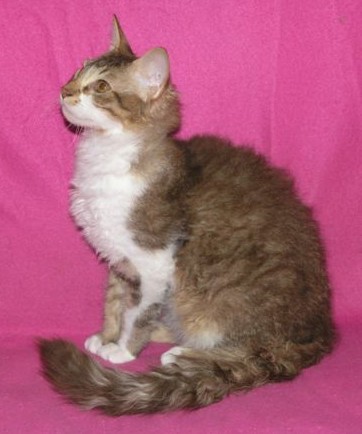
The most distinctive feature of this breed is, of course, the coat. Guard hairs, awn hairs, and down hairs are present, which would make the coat relatively normal if it weren't for the curls. The curls are responsible for the coarse texture. Because of these curls the coat stands away from the body. The longest hairs should be around the neck, creating a ruff effect. Even the whiskers, eyebrows, and the hairs in the ears are curly.
There is both a shorthaired LaPerm and a longhaired LaPerm. The longhaired cat has a plume to its tail while the shorthaired cat has a tail that resembles a bottlebrush. Coats are thicker and fuller in the cooler months, and older cats tend to have a more developed coat than the younger cats. All coat colors and pattern are acceptable provided the coat is the traditional LaPerm coat.
Another benefit of this coat is that it does not tangle and doesn't fall out (think poodle, but in cat form). A light brushing once a week will remove any loose hair and keep the coat bright and shining.
The Personality of the LaPerm
Unlike some of the more aloof breeds, the LaPerm loves to be around people and can be found sitting on laps, shoulders, and sometimes heads (as my son will attest to). They make incredible family cats as they are gentle, patient, and friendly. A LaPerm will generally get along well with children and other pets. They're also incredibly entertaining with their kitten like antics. A LaPerm will never grow out of this kittenish attitude.
If you're looking for a cat that doesn't shed a whole lot, is great with kids, and is a bit of a clown, the LaPerm might be for you.
Some cat breeds aren't yet recognized by the majority of associations but may eventually attain championship status. Sometimes this lack of status is because a breed is so new. Sometimes, however, it's simply that the breed is virtually unknown. The Kurilian Bobtail fits squarely into the latter category.
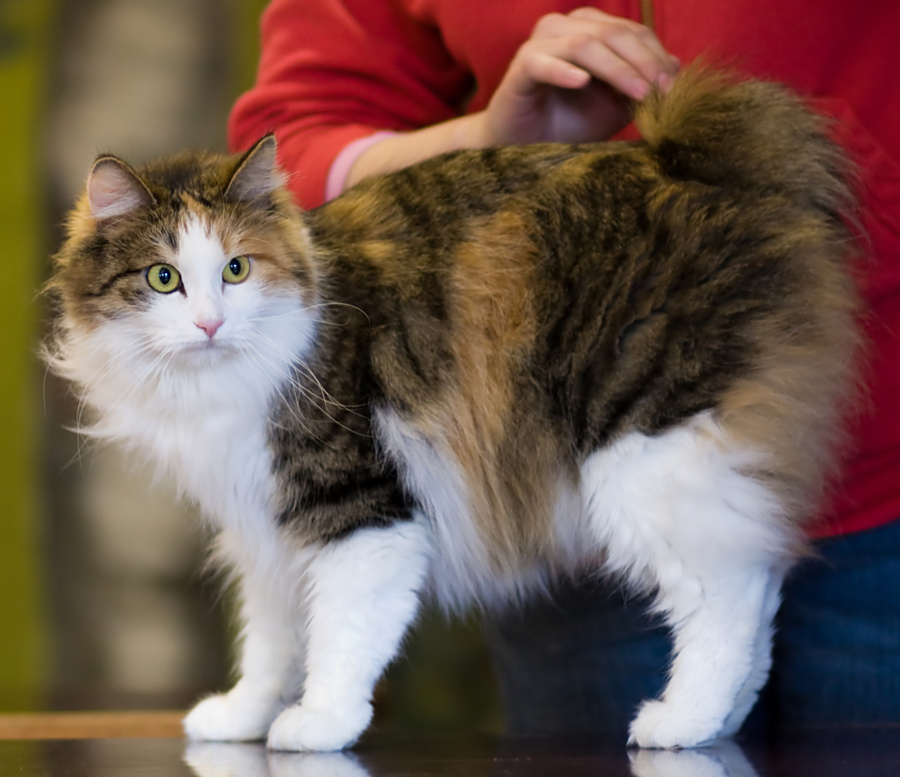
The Kurilian Bobtail is a breed that developed naturally on the Kuril Islands. These stretch from the Japanese island of Hokkaido to the edge of Russia. These cute cats with their little bobtails have apparently been running around the Kuril Islands for at least two hundred years, but they weren't brought to Russia until the middle of the 20th century. And they didn't make it to North American until even later than that. Even today there are less than a hundred Kurilian Bobtails in the United States. No wonder the breed hasn't been recognized.
Despite their undeniable cute factor, the Kurilian Bobtail is actually a rather large cat with an almost-cobby body shape. The coat is fluffy and soft with either long or short hair. Like many other breeds, both coat lengths are acceptable. Color is equally varied with both solid and tabby colors showing up in the same litter.
The most distinctive trait of the Kurilian Bobtail is, of course, the tail. There are dozens of different tail structures, each its own variation of a little pom-pom. The tails should be fluffy and held tight to the body.
As house pets, this breed gets along with just about everyone. Children, cats, other pets, all are accepted by the sociable Kurilian Bobtail. They like to play games, especially games involving running or jumping, so they're good cats for a high-activity household. They're not entirely happy on their own, but they do well enough with another cat or even a dog. You can also entertain them wish a fish tank, but make sure it's well secured. They are a curious breed, after all.
The Kurilian Bobtail may never become a recognized breed, but if it doesn't it's only because they're so rare. Incredibly rare might be the better way to describe this energetic breed. If you do come across the Kurilian Bobtail, you're in for a treat.
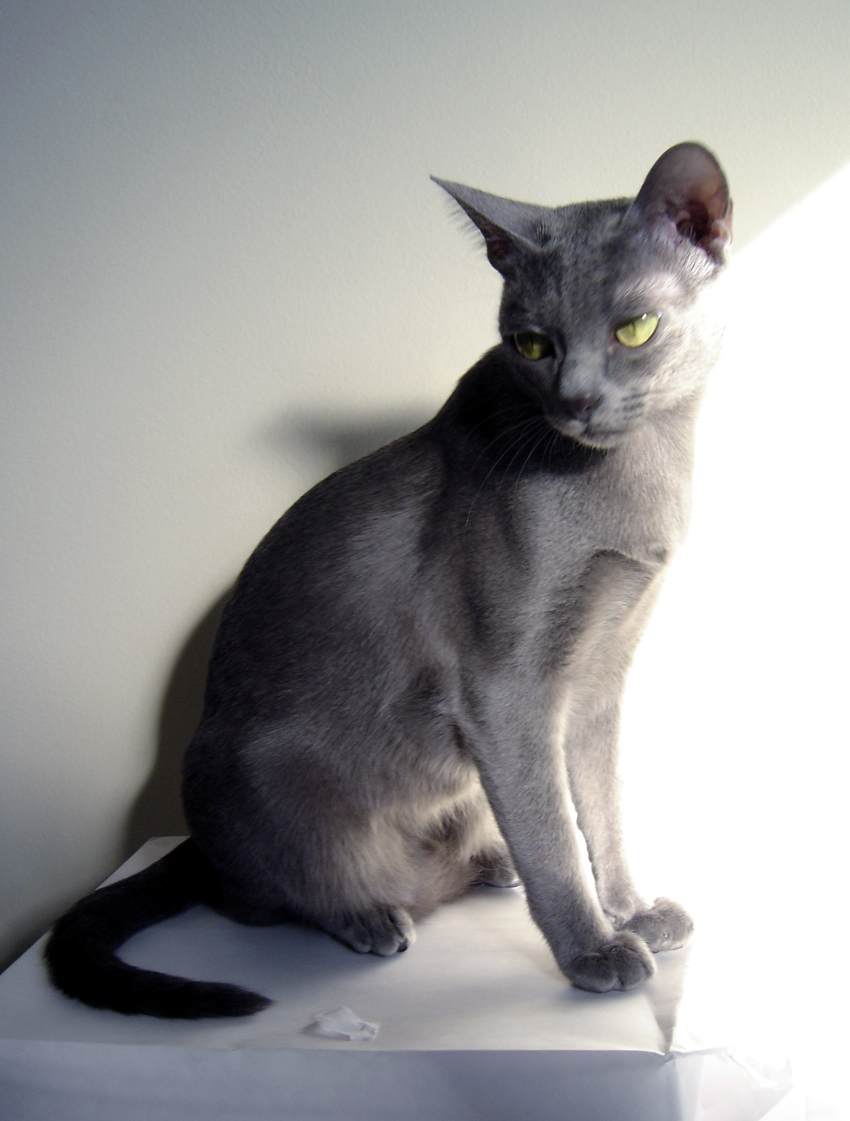
The Korat has been around a long time. The earliest known picture of this elegant breed appears in The Cat-Book Poems. Written sometime between 1350 and 1767, this is probably the oldest manuscript devoted exclusively to cats. There is an illustration within this book that features a cat that looks remarkably like the Korat. This cat, along with the other cats in that illustration, were thought to bring good luck. In more modern times, the Korat first appeared in England. in the late 1800s. They were shown as "Blue Siamese" between 1889 and 1896, but because they didn't conform to the traditional Siamese standards they disappeared from competition by 1901. It wasn't until 1959 that the first breeding pair of Korats were imported into the United States. Though they were not immediately accepted into championship status, several breeders persisted and by 1966 they were competing with the other recognized breeds. The Appearance of the Korat There is no mistaking the Korat. With their bright blue coloring (or as bright a blue as cats get), they stand out in the crowd. And though the blue color might be the only accepted color in most associations, some groups accept lilac and pointed cats as well. The coat is short, making grooming a breeze, and they are an about average shedder. The Korat is a medium sized cat with a powerful and muscled body. Unlike many other cat breeds, the Korat can take up to five years to reach maturity. During this time, they may be lanky until they fill out. Their eyes will also change. Though blue as kittens, the eyes will eventually shift to bright amber when they are only a few weeks old. Then the eyes will change again, this time to a brilliant peridot, when the cat is between two and four years of age. When the eye color changes to peridot, the cat is nearing maturity. The Personality of the Korat Active and intelligent, the Korat will quickly form a strong bond with its family. They are affectionate creatures prone to cuddling or simply following at your feet. Be prepared to trip on your Korat several times a day. That or shoo him off the counter whenever he jumps up for a snuggle. This breed doesn't like to be alone, so if you're going to be gone for several hours at a time, consider getting a second Korat so they can keep each other company. For some ridiculous reason, these cats like to hang out with humans, and they like to hang out with each other, but they don't tend to like other cat breeds very much. Korats love Korats. Stubborn little brats. Though this cat is among the more active breeds, it's also a great breed to have with children. They love to play and can handle some minor roughhousing, but they're incredibly gentle at the same time. They also like to chirp, which is endlessly entertaining for children and adults alike. Korats don't really like loud noises as a general rule, but they seem to make an exception for children. A hardy cat, the Korat is the perfect fit for families with children provided there aren't other cats (unless they're Korats too) and dogs. Or small pets. These guys are active enough to hunt just about anything. For the cat-loving household, Korats can provide endless entertainment and love.
Many of today's cat breeds are fairly new, but some of them are truly ancient. The Japanese Bobtail has been around for at least a thousand years. Their existence has been documented in Japanese writings and paintings for at least that long. They're considered good luck in Japan and around the world. The first Japanese Bobtails appeared in North America in 1968 when Judy Crawford sent several of the cats to Elizabeth Freret. Later, when Judy returned to the United States herself, she brought several more cats with her. The two women worked tirelessly to have the cats recognized as an independent breed, but only the shorthaired version of the breed was recognized in 1979 by TICA. The longhaired version wasn't recognized until 1991. Today, most associations recognize the shorthaired Japanese Bobtail, but the longhaired cat is still sometimes refused championship status. The Appearance of the Japanese Bobtail The single most distinctive feature of the Japanese Bobtail is the little bob that serves as a tail. This bob is unique to each cat and may include kinks, curls, curves, and angles. The tail should be very close to the body, appearing as no more than a pom-pom at the end of the spine. The hair on the tail should be longer than the hair on the body. The bones of the tail are fragile and require careful handling. They're also typically fused, making it possible for this delightful cat to actually wag its tail. The coat may be either short or long, but it must lack an undercoat in either case. This is what makes the coat lie flat against the body. Even the longhaired variety isn't 'fluffy' in the traditional sense. There should be relatively little shedding and the silkiness of the coat itself keeps matting to a minimum. A weekly brush keeps the coat in pristine condition. Coat colors are many and varied. The traditional color is a mainly white body with black and deep red markings, but other colors are also accepted. There are just as many options for eye color, but blue or even eyes of two different colors are preferred over all others. This medium-sized cat should weigh no more than 10 pounds. The hind legs should be powerful, giving the Japanese Bobtail its extraordinary jumping ability. The body itself should be slender yet strong. The head should be triangular with large eyes and ears set high upon the head. The Personality of the Japanese Bobtail Many cat breeds are intelligent, but the Japanese Bobtail is exceptionally so. They are active and love to talk, so expect a lot of chirp and meows if you have a Japanese Bobtail in your home. This cat also loves to play, especially if the game involves running and jumping, so search out cat toys that allow the cat to indulge in these activities. You'd be hard pressed to find a breed that is more loyal to their family. Despite this, they are not lap cats. They'll often be found crawling on top of cupboards or perched on top of the fridge, but they are only rarely caught snuggling up to a human. They prefer to show their love by staring at you like you're the only thing that matters. The Japanese Bobtail is sweet, intelligent, and fun-loving. They enjoy many hours spent chasing a ball or an afternoon of climbing the curtains. If you're looking for a cat that is independent and loyal, the Japanese Bobtail might be for you.
Colorpoint cats such as the Siamese have always held a mystical quality, one that has attracted many cat fanciers over the years. But, until the 20th century, colorpoint breeds all had short hair. If you wanted a longhaired version, you had to cross a colorpoint breed to a longhaired breed and hope you got a longhaired kitten with colorpoint markings. But in the 20th century, all that started to change. It began in the early 1930s in the United States. Clyde Keeler and Virginia Cobb began an experimental breeding program. They hoped to achieve a more stable longhaired breed that had colorpoint markings. This program had its ups and downs, meeting with only limited success. In the 1950s, however, Ben Borrett started a similar program in Canada. This program was much more successful, and in 1955 the Governing Council of the Cat Fancy (GCCF) recognized the Colorpoint Longhair as its own breed, but this wasn't the end of the story. Around this same time, Marguerita Goforth began her breeding program. Her goal was to create a Persian-type cat with Siamese markings. She was also determined to have the Himalayan recognized as its own distinct breed, and not simply another colorpoint breed. Through her efforts, the Himalayan was given Championship status in 1957. Since that time, the Himalayan has been a well established breed. The Appearance of the Himalayan If you picture a "Persian with Siamese markings", that describes a Himalayan perfectly. This regal cat even has the bright blue eyes of a Siamese. The Himalayan is a medium-sized cat with a cobby body. Like the Persian, the Himalayan should have a large, rounded head and a thick neck. Ears should be small and set low on the head. The tail should be short, at least when compared to most other breeds, but still long enough to give the cat a balanced look. The coat is very much like the Persian coat, long and silky. The top coat should be shiny and the undercoat just thick enough to make the cat appear quite fluffy. This combination results in many, many tangles, so consider a Himalayan only if you're willing to groom your cat daily. This breed needs it. As for color, the body of the cat should be a uniform cream (or similar shade). The points (ears, face mask, tail, legs and feet) should be a contrasting color, and it is this color that is considered the color of the cat. The Himalayan can be found in lavender, chocolate, seal point, and several other colors. Basically, if the Siamese comes in that color, so does the Himalayan. The Personality of the Himalayan Loving and affectionate, the Himalayan is the ultimate lap cat. They're not all that active, preferring to cuddle instead. Like the Siamese, they are quite vocal, so expect your day to be filled with chips and meows. Maybe even a few yowls if they get annoyed enough. Though they do like to play a little, especially with scrunched up paper, they don't do well in high activity households. A quieter home is better suited to this elegant breed. They get along with other pets and even children, but they don't like to be bothered. So if you're going to bring a Himalayan into your home, teach children and even adults how to behave around your new feline companion. Himalayans are sweet and loving. They make great companions for the elderly or those who live alone and need a friend. But they require extensive grooming and they don't like to be home alone. If you're home a lot and don't mind brushing out your cat on a daily basis, the Himalayan might be for you.
Some breeds are newer than others, and the Highlander is one of the newest of them all. This hybrid cat breed can trace its roots only to 2004, but the cats chosen to initiate this new breed were not of any specific existing breed. Instead, individual cats were chosen based on their physical traits. Because the breed is so new, it is only recognized by a handful of associations as a preliminary or new breed. The International Cat Association (TICA) acknowledged the Highlander in 2008, but this breed has not yet gained wide acceptance. The most defining characteristic of the Highlander is the ears. They feature a loose curl in the top third of the ear. The curl is similar to the American Curl, and yet distinct enough to set the Highlander apart from the more established breeds. The ears are placed high atop the head and are wide and open at the base. Highlanders come in both long and short hair varieties, and any an all coat colors and patterns are acceptable. The long hair variety should be groomed at least twice a week to avoid matting while cats with shorter hair should be groomed twice a week, just like most other breeds. The coat is typically soft and might even feel silky. The rest of the cat is strong and substantial. The forehead is sloped while the nose and muzzle have a squared appearance. Eyes are very much like slightly flattened ovals, giving this cat breed an intense and almost intimidating stare. The body should be large and muscular, almost reminiscent of a wild lynx or even a bobcat. The tail is short, usually about an inch, but this is natural and not the result of docking. The tail, which may have kinks or curls, is highly expressive. Some Highlanders will even wag their tail very much like a dog. But make no mistake--they are cats through and through, right down to the way they play. Highlanders are clowns at heart and can often be found chasing their own tails or waiting behind a curtain to pounce on an unsuspecting human (or fellow feline, or canine, it doesn't seem to matter). These cats love humans, so expect to be met at the door, tail held high, even if you've only been gone for five minutes. These cats love to indulge in antics that have the appearance of insanity. This friendly cat is great with children, is able to live with other animals, and adapts easily to most living situations. If you're looking for a cat with a playful personality and a unique appearance, the Highlander might be for you.
The Havana (once called the Havana Brown) has its origins in the early 1950s. Hoping to breed what was essentially a dark Siamese, breeders crossed Siamese cats with black domestic shorthairs and even a few Russian Blues. The results were varied for a while, but eventually Elmtower Bronze Idol, the first of the Havanas, was born. He was the result of a controlled crossing between a black domestic shorthair and a Siamese. Then in 1958 the breed was recognized by the Governing Council of Cat Fancy, but it was listed as the Chestnut Foreign Shorthair. The name Havana Brown would be adopted in 1970, and later (1983, specifically) the 'brown' portion of the name was dropped entirely. There are really two lines of cats these days. English lines are more oriental looking, but American lines tend to have a more angular look and are more in keeping with the original appearance of the Havana. The Appearance of the Havana This medium-sized cat has a body type that seems foreign and familiar all at the same time. Weighing no more than ten pounds, the Havana is a firm and muscular cat. This makes him both powerful and graceful. The muzzle of the Havana is unique in that it just seems to stop, leading to a blunt appearance. The ears tend to be larger than the norm, but not so large as to seem ridiculous. There is only one acceptable eye color--green. The Havana comes in two colors, lilac and brown. Some associations still only recognize the brown, but the lilac cats are just as lovely. Kittens are sometimes born with tabby markings, but these disappear as the cat reaches adulthood. Whiskers should match the coat color. Grooming is easy because the hairs are short and flat. A weekly brushing to remove loose hair is all that is usually required. If you want your cat to gleam like those show cats, rub him with a chamois cloth. I know, I know. They're for cars (and you typically buy then at auto supply store). But they are also for cats. Try it and you won't be disappointed. The Personality of the Havana Some cats are so people-oriented that they can't bear to be deprived of attention. The Havana falls squarely into this category. They really can't be left alone all day while you're off at work. They need affection and companionship. If you think you might leave your cat alone, get a companion cat or two. A group of three Havanas does better than a single cat left home alone. This cat will follow you around and investigate everything you do. They tend to be a little vocal, so you'll know when kitty isn't getting enough attention. This is the cat who will sit on your paper or lay on your computer until you play with him. You'll want to invest in cat toys and cat trees to keep this active breed busy. But this still won't be enough. The Havana needs interaction, so you can't buy a bunch of cat trees and expect him to entertain himself all the time. Play with him or you'll end up with a neurotic kitty on your hands (and under your feet). The Havana is a robust and healthy cat, one that makes a terrific house pet for individuals or families who are home often. If you want a cat who will play with you, sleep on your pillow, and basically stalk your every move, the Havana might be for you.
When breeders started experimenting with a cross between the American Shorthair and the Persian, the goal was to get something that looked like a Persian but with much shorter hair. The kittens of these crosses did look like Persians, but they lacked the truly short coat of the American Shorthair. The hair was shorter than the Persian, but not quite short enough. Still, there was potential in these kittens, and a woman by the name of Jane Martinke saw it. She called the silver-colored kittens Sterlings, proposing that this be the name of the new breed that would eventually be developed. The idea was still to keep crossbreeding in the hopes of attaining a short and plush coat. After consulting with several other breeders, the name was changed to Exotic Shorthair, opening the door for other colors and crossbreeds. Time passed and different breeders used different crosses to get the look they desired. Some used the Russian Blue, others the Burmese, but all kittens were bred back to Persians in an attempt to keep the Persian body type. Because Persian breeders themselves didn't want to get involved in the development of the Exotic Shorthair, the breed came along slowly. It wasn't until 1979 that The International Cat Association (TICA) decided to grant the Exotic Shorthair championship status. The Appearance of the Exotic Shorthair The Exotic Shorthair has a dense bone structure, making them heavier than they appear. The head is broad, the ears low set, and the face short and round, leading to a sweet expression that contributes to the popularity of this breed. The body should be short, almost square, with thick legs and a thick tail that is shorter than the average breed. The coat is thick and plush, but not as long as the Persian. They come in all colors and patterns, all of which look like little plush toys owning to the shape of the head and body. This breed does need to be groomed regularly, but grooming is not as difficult as with the Persian. A quick brush once a week and a wiping of the eyes (to prevent buildup that can lead to irritation) is generally all that is required. The Personality of the Exotic Shorthair A quiet breed, the Exotic Shorthair is gentle and affectionate. This is a cat that will jump into your lap for a cuddle as soon as you sit down. This cat inherited the easy-going nature of its American Shorthair ancestors, making it the perfect companion for children and other pets. This cat loves to play and can amuse itself for hours if provided with a few toys and something to climb on. This means the Exotic Shorthair can be easily left at home while you go off at work. Your cat will be excited to see you when you get home, but he won't be totally lonely if he has a few interesting cat toys. Known Health Issues of the Exotic Shorthair Unfortunately, the Exotic Shorthair inherited a few health problems from its Persian ancestors. Inherited polycystic kidney disease (PKD), which can cause cysts in the kidneys, is common. The cysts are present at birth, but enlarge and cause severe problems once the cat reaches adulthood. The first signs of this disorder usually appear between three and four years of age. The cat may initially lack an appetite and be very thirsty, but irreversible kidney failure is the ultimate result. Breeders can screen their cats for this disease, but it's expensive. Expect to pay more for a kitten that is guaranteed to be free of PKD. Other health problems can be traced to the brachycephalic face. The broad and short skull can cause eye and breathing problems. There may be chronic sinus difficulties and even kinked tear ducts, so good and regular vet care is important for the Exotic Shorthair. The Exotic Shorthair is sweet and loving. If you're looking for a cat who will fit right into your family like he's been there for years, this adorable breed might be for you.
Mau is the Egyptian word for cat, so the Egyptian Mau is really the Egyptian Cat. Genetic testing has proven conclusively that the Egyptian Mau really did originate in Egypt. In fact, ancient artwork in the region depicts cats that are very similar in appearance to the modern Mau. Unfortunately, the Mau had a hard time in the early part of the 20th century, almost going extinct during WWII.
In 1956, that began to change. Three cats were imported to the United States from Italy. Two of these were female, one was male, and all were Egyptian Maus. The gene pool was limited, but with precise crossbreeding, inbreeding, and the importing of suitable cats, the breed stabilized and was accepted by The International Cat Association (TICA) in 1979. Today, most cat associations recognize the Egyptian Mau as a championship breed.
The Appearance of the Egyptian Mau
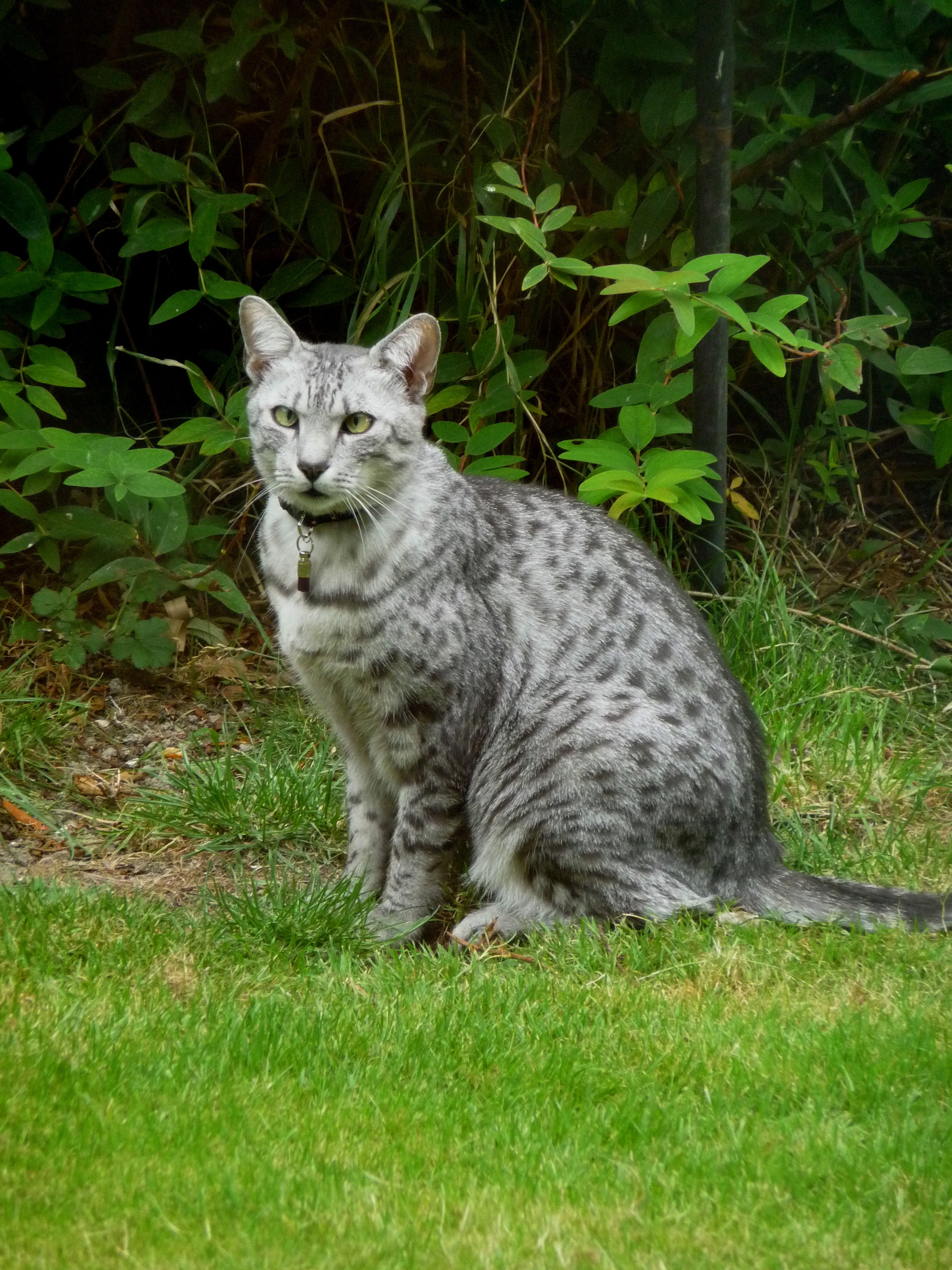
This muscular breed is elegant and has a regal bearing. Its coat is medium in length; its texture varies with the color of the Mau. Smoke colored cats have a fine and silky coat, but silver and bronze cats sport a dense and soft fur that is a pleasure to touch. All cats have gooseberry green eyes shaped like medium-sized almonds. The eyes slant towards the ears, giving the cat a slightly worried look. The ears are large and broad, giving the Mau an inquisitive appearance. These ears are very keen, making the Mau especially sensitive to sounds.
The most distinctive quality of the Egyptian Mau is the brilliant coat. Maus are the only naturally spotted domestic cat breed; all other spotted breeds were bred with wildcats to achieve the spotted effect. There is a marked difference between the coat color and the spot color, so the spots stand out in sharp contrast. The size and shape of these spots is mostly random.
All Egyptian Maus have a mark in the shape of an "M" on the forehead. This is often called the Mark of the Scarab. A dorsal stripe runs the length of the spine, covering the back and the tail all the way to the tip. The neck, upper chest, tail, and legs are all striped with the shoulders showing a transition between spots and stripes.
The Personality of the Egyptian Mau
This breed is shy and incredibly sensitive. They don't like loud noises and they despise anything that disrupts their daily routine. They do best in a quiet household free of too much noise. The Egyptian Mau is not the kind of cat that likes to live with a party animal and they tend to do better in homes without young children.
But the Egyptian Mau will bond to a sensitive and quiet individual. Once this cat is bonded, it will remain intensely loyal and loving towards its person. If a Mau truly bonds to you, you'll find yourself on the receiving end of more affection than you'll know what do to with. The cat will want to be with you always and will make little chirping sounds when happy. Expect the Egyptian Mau to be involved in everything you do because it's hard to avoid them when they want to be the center of attention.
Known Health Issues of the Egyptian Mau
For the most part, the Egyptian Mau is a stable and robust breed. They have very few inherited health problems, but some lines are prone to luxating patella (slipping kneecaps). Ask your breeder about this problem and consider getting a cat from a line that has not exhibited this condition.
The Egyptian Mau is a sweet and loving cat who needs a quiet space to be happy. If you are the type of person who likes to sit and read a book late on a Friday night, this loyal breed might be for you.
Some breeds fall somewhere between hybrid and purebred. This is the case with the Donskoy. Currently, the Donskoy cat is assigned to the Preliminary New Breed Category. This means that the cats can be shown in The International Cat Association (TICA) but they cannot earn titles. Eventually, if it becomes stable, this cat breed is expected to attain championship status and will be eligible for titles.
The Donskoy breed is the result of a spontaneous mutation. In 1987, a woman by the name of Elena Kovaleva rescued an abused kitten in Russia. The cat had been sealed inside a bag and used as a soccer ball by several young local boys. This kitten survived its ordeal but was so stressed that its hair began falling out. Eventually, the kitten, a female Kovaleva named Varvara, was completely bald. The hair never grew back despite being treated by several veterinarians.
As an adult, the hairless cat gave birth to a litter of kittens. These kittens were born with hair, but shortly after birth their hair began falling out and never grew back. This led some people to believe they were unhealthy and Kovaleva was encouraged to get rid of them. Luckily, a local breeder by the name of Irina Nemikina rescued one of the kittens. It took several years and a dedicated breeding program, but Nemikina eventually created what she called the Don Sphynx (Varvara was originally found beside the river Don and the hairless nature of the coat made the cats look like the Sphinx). When the breed was registered with TICA, it was given the name Donskoy.
The Appearance of the Donskoy
The most important trait of the Donskoy is the coat. There are actually four acceptable coat types, all but one of which results in hairlessness. The four coat types are Brush, Flocked, Rubber Bald, and Velour. Brushed kittens are covered in a wiry, soft, and wave coat. Shortly after birth some hair will fall out, resulting in bald spots on the head, upper neck, and back. Flocked kittens appear hairless at birth but are really covered in a thin soft chamois. This usually falls out and you get a bald cat. Rubber Bald kittens are born bald and stay that way. Velour kittens have a wool-like coat with a bald spot on the top of the head. The coat disappears in the first year, sometimes leaving some hair on the face, legs, and tail. The Donskoy is unique among cats in that it can grow a winter coat. This coat falls out again as the weather warms. They don't have a lot of hair (none in many cases), making them easy to groom and cutting down on shedding.
The skin of the Donskoy should feel velvety and hot to the touch. There should be pronounced wrinkles caused by the incredible elasticity of the skin. These wrinkles should be most noticeable on the cheeks, jowls, and under the chin. Vertical wrinkles should separate the ears and run straight down the forehead. There should also be significant wrinkles on the neck, chest, legs, underbelly, and the base of the tail. The skin itself is like human skin, meaning cats can get tanned and even turned by too much sun exposure. A natural sunblock is recommended for cats who spend a great deal of time outside.
The Donskoy is more than just its coat and skin. It is a strong and sturdy cat with powerful hind legs. These cats are medium in size with males typically being larger than females. The Donskoy breed is not a delicate one. They are hardy cats that can give as good as they take.
The Personality of the Donskoy
Intelligent and inquisitive, the Donskoy is a joy to have around. This cat is a social butterfly and loves to be the center of attention. They will play with both children and other pets and generally adapt to changes well. Active and athletic, they don't mind a good romp, but they also make perfect lap cats, especially with their warm bodies. Cuddling this cat is relaxing, and the cat enjoys just as much as the person.
These cats take a keen interest in their surroundings. They will constantly use whatever is around them to make up new games. They're not all that destructive, but they are almost too social. Everyone who comes through the door will be greeted by the Donskoy, who will usually assume the visitor is there for the cat's amusement alone.
The Donskoy is more than just social; the breed is also highly intelligent and responsive to humans. This means you can train your cat to respond to voice or hand commands. If there's a way to be involved, the Donskoy will take it, even if it means following rules.
If there's one downside to these cats, it's that they cannot be left alone. Not all. Not for a few days while you're way. Not for twelve hours while you work. Not for a couple hours while you run to the supermarket. They need companionship or they'll pine and sometimes become unhealthy. The Donskoy is a good pet for someone who works at home, but even these people will sometimes have to go out. Consider getting two, or even getting a dog. This way your cat will not be truly alone.
The Donskoy is a fun-loving and passionate cat breed well suited to most living situations. Though they are a little on the expensive side and can be difficult to find, they fit into most families and bring smiles to everyone who encounters them.
The origin of the Devon Rex cat can be traced to Buckfastleigh, Devon in 1960. There was a feral tom living in an abandoned mine there, one with a curly coat. A woman named Beryl Cox adopted a stray tortie and white female. These two cats inevitably mated, and one of the kittens, a male, had a curly coat just like his father's. This kitten was named Kirlee.
At first it was thought his traits could contribute to the emerging Cornish Rex, but Kirlee's genes were just different enough. Kirlee's whiskers, for example, were stubby, sometimes entirely missing. The Cornish Rex exhibited curled whiskers. Kirlee's hair was tightly curled and not at all uniform. The Cornish Rex had a uniform coat. Kirlee had large eyes, a short nose, and low-set ears. The Cornish Rex did not.
Clearly the genes controlling the two mutations were different. To distinguish them, the Cornish gene was labeled Gene 1 while the Devon gene was labeled Gene 2. Every Devon Rex that has appeared since 1960 carries Gene 2 and can trace its lineage back to Kirlee.
The Appearance of the Devon Rex Cat
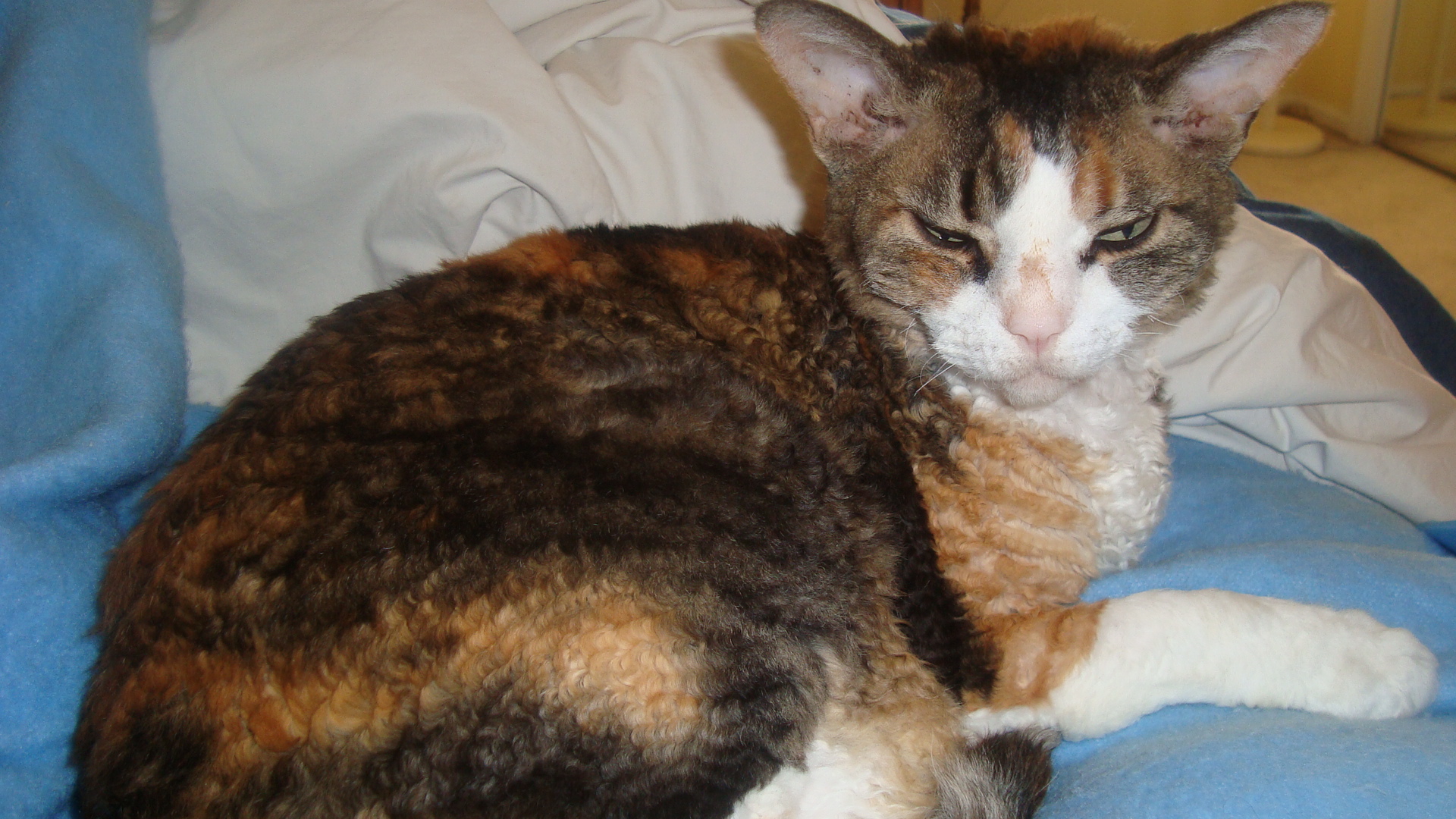
At first glance the Devon Rex can seem a little strange. This breed is on the smaller side, generally weighing no more than nine pounds. Like most breeds, females are smaller than males. They are all athletic and have strong muscles. The hind legs are a little longer than the forelegs, giving the cat a slightly lopsided appearance. The ears are huge and the face is shaped like a wedge. In the right light, the Devon Rex almost looks like a rogue pixie. The whiskers and eyebrows of this cat are short and curly, or even missing entirely.
Though the preferred coat is as even as possible and full of loose curls, coats actually vary greatly. Some cats have thick coats, others have sparse coats, and some even have bald patches all over their bodies. This doesn't indicate illness of any kind. It is simply the way Gene 2 expresses itself in different cats.
The coat also changes appearance over the course of the lifetime of each individual cat. Devon Rex cats molt occasionally, causing the coat to break off. They can appear to have a short coat with no curls, or even no coat at all, until the curly coat grows back. Molting is not a fault; it is simply the way these cats are.
When compared to most cats, the body of the Devon Rex is extremely hot to the touch. Some people think this is indicative of illness at first, but it's entirely natural. The coat is so short that it does nothing to keep the body heat next to the body. Because of this trait, these cats get cold easily. They often search for warm places to sleep and can be found stretched out on a radiator or curled up in the sunniest spot in the house.
Grooming the Devon Rex is quite simple since this cat breed doesn't shed much. A quick brush with a grooming mitt once a week is usually all that is required. Because of the short coat, an actual brush is not recommended. The oversized ears can collect grease and dust, so they should be cleaned with a soft cotton ball dipped in baby oil.
The Personality of the Devon Rex Cat
The Devon Rex is playful, intelligent, and loving. This is a highly active breed that likes to climb and run. They have a powerful need to be with people and don't like being left alone. In fact, this cat breed can be destructive when left alone for long periods of time. If you tend to be away for more than four or five hours at a time, a companion cat is a good idea. With a friend, your Devon Rex may be less inclined to destruction and more content to wait for you to arrive home.
This cat is good with children, other pets, and random visitors who might drop in for tea. In fact, the busier your household is, the happier your Devon Rex will be. They love to be the center of attention, so expect your cat to be around whenever there's a crowd. They're not as talkative as the Siamese, but they do make soft chirping sounds if they feel they're being ignored.
Known Health Issues of the Devon Rex
Like many specialty breeds, the Devon Rex suffered from inbreeding in its early years. This has led to some common health problems including coagulopathy (a clotting disorder), luxating patella (slipping kneecaps), and inherited spasticity (spasms). Genetic testing and limited outcrossing are both being used to help reduce the occurrences of these problems.
If you're looking for a cat who has a sweet nature and a slightly different appearance, the Devon Rex might be for you.
Massive change such as a world war often triggers genetic change. This is how the Cornish Rex first developed. On July 21st, 1950, a litter of five kittens was born in Cornwall, England. One of these five kittens was a curly coated, cream male. This kitten was named Kallibunker by his owner, Nina Ennismore. Ennismore assumed that the coat was the result of a spontaneous mutation, the same kind that had been seen in horses, rats, and mice.
Under the advice of geneticist A.C. Jude and cat fancier Brian Stirling-Webb, Ennismore bred Kallibunker back to his mother (a tortie-and-white shorthair named Serena). This breeding produced two males and a female in the later summer of 1952. Both males had the curly coat of their father. One of these died before reaching seven months of age. The other was named Poldhu and is considered the father of the Cornish Rex cat breed, which was named because of its place of origin.
The problem with the foundation stock, including both Kallibunker and Poldhu, was one of a limited gene pool. There just weren`t that many Cornish Rex cats. So Ennismore had to inbreed her cats quite a bit. Knowing this would eventually compromise their health, she began to outcross to ordinary shorthaired cats. Though she might have introduced the gene into any number of breeds, she chosen to stick with shorthairs, mostly because a longhaired Cornish Rex would suffer from constantly matted hair.
After having achieved a cat population of more than forty cats, Ennismore discovered she could not sell enough of her unique cats to stay financially afloat. She chose to put many of her cats to sleep, the aging Kallibunker and Serena among them. She might have still had Poldhu, but two veterinarians performed a testicular biopsy in an attempt to determine if Poldhu was simply a blue-tabby-and-white stud or something more rare, siring blue cream and white. Females of this latter sort were common, but males were rare. Even more rare was a male of this sort who was fertile. Most were born sterile.
Though the vets promised Ennismore that Poldhu`s fertility would not be damaged, he never sired another litter after the biopsy. To make matters worse, the sample extracted from Poldhu was lost somewhere in the laboratory, rendering the entire procedure worthless.
This might have spelled the end of the Cornish Rex if not for Brian Stirling-Webb. In 1962, he learned that a male Rex kitten had been born in Devon. The woman who owned this kitten (named Kirlee) offered him to Stirling-Webb, hoping this would inject new blood into the failing Cornish Rex breed. Stirling-Webb bred Kirlee to the Cornish Rexes, but this resulted in kittens with straight hair. It became obvious that the Kirlee did not share the same mutation as the Cornish Rex cats. Luckily further test matings proved that the German Rex cats, developed independently in Germany, were compatible with the Cornish Rex. This allowed the Cornish Rex to continue in England.
Across the ocean, the Cornish Rex was also beginning to thrive. Before giving up her cats in the 1950s, Ennismore had sent several to American breeders. Most of these breeders were actually Siamese breeders, so they used their Siamese cats to enhance the Cornish Rex. This introduced a triangular head shape, fine bones, large ears, and a look reminiscent of the Greyhound dog. In a sense, they created the look of the Cornish Rex we are now familiar with.
The unique look of this breed was popular with cat fanciers and enthusiasts around the world. slowly gained acceptance around the world as a distinct and separate breed from the Devon Rex, beginning with the Canadian Cat Association and the American Cat Fancier`s Association in 1963. The Cat Fancier`s Association, however, continued to see the two breeds as one, registering both as Cornish Rex, until 1979.
The Appearance of the Cornish Rex Cat The physical appearance of the Cornish Rex is unique and a little disconcerting the first time you see one. They`re tall and slender, a little like the Siamese, and have a dainty appearance. Even so, they are strong and well muscled. The power in their legs allows them to leap to astonishing heights. The body itself flows from head to tail.
The ears are rather large and placed on top of the head. The eyes are oval and have a slight upward slant. This, combined with the triangular head, gives the cat an exotic appearance. The body temperature of the Cornish Rex is also higher than would be considered normal for most cats.
But the thing that defines the Cornish Rex is the coat. The coat is short and curly, with even the whiskers and eyebrows having significant curl. There are no guard hairs at all on this breed of cat, so the Cornish Rex is usually soft to the touch. Because of the lack of guard hairs, the coat doesn`t require much in the way of grooming. The coat may be of any color and pattern.
The Personality of the Cornish Rex Cat
If your looking for a cat that is unreserved, friendly, and intelligent, the Cornish Rex might be for you. These unique cats have an almost fanatical need to be the center of attention. Sometimes called the Velcro cat for its need to near people, the Cornish Rex isn`t as independent as some other breeds. They don`t like to be left alone, so this isn`t a good pet for people who are gone twelve hours a day.
The Cornish Rex is full of energy and loves to play games. This is a cat that will love being taught to fetch and will even roughhouse with children to some extent. As long as they can have positive attention, this cat breed will do almost anything and are the entertainers of the cat world. They tend to be excellent with children and adapt well to most situations.
For all that it loves to communicate, the Cornish Rex isn`t a vocal breed. Instead, this cat will get his message across with body language and friendly antics. They use their tail, ears, and paws to tell their story, so watch your feline friend closely if you choose one of these cats.
Known Health Issues of the Cornish Rex
The Cornish Rex has very few genetic health issues, none of them serious. This is a hardy breed that generally enjoys good health. It should be noted, however, that they do have very short hair and have no guard hairs. This means they`re not suitable for colder climates and generally benefit from a cat sweater. You should also clean the ears and between the toes as these areas tend to get greasy.
Is the Cornish Rex Hypoallergenic?
This question comes up a lot, mostly because there are some dog breeds (Poodles among them) with curly hair that does not shed. These dogs are generally considered hypoallergenic as their coat minimizes the risk of allergic reaction. But a cat is not a dog, even though the thought in the 1950s was that the Cornish Rex would turn out to be hypoallergenic.
The problem is root of allergies. In dogs, it's usually the dander. So if the hair doesn't fall out, there's no dander on the couch to cause a reaction. With cats, however, the reaction is typically to the protein Fel D1 (which dogs don't have). This protein is present in the skin, dander, saliva, and urine of cats, including the Cornish Rex. To state it simply, coat type has no impact on allergies, so the Cornish Rex is not hypoallergenic.
The Cornish Rex may not be considered hypoallergenic, but it's still a wonderful and loving companion. These sweet natured felines make excellent pets for many families around the world.
Some breeds are so new they're only recognized by The International Cat Association (TICA). And some of these are allowed to compete in TICA sanctioned shows, but they cannot earn points or titles yet. So it is with the Chausie (pronounced chow-see). This breed, classified as an advanced new breed by TICA at the time of this writing, is not yet a truly recognized breed, but it is well on its way to becoming one.
Though the idea for this breed has its roots in the late 1960s and early 1970s, it was not until 1995 that the Chausie achieved foundation registry with TICA. This was after jungle cats from south central Asia were crossed with Abyssinians. It was a further six years before the breed was advanced to evaluation status. In 2003, the Chausie was granted advanced new breeds status, where it remains as of this writing. Chausie cats can compete in shows, but not yet earn points or titles.
The Chausie, which can weigh up to 30 pounds, is a large-sized cat with a short, fuzzy coat and ears that are a little larger than normal. There are only three color combinations allowed. These are brown ticked tabby, black grizzled tabby, and solid black. The coat is short enough that it needs very little maintenance, but it will become dull if not brushed regularly. To keep your cat looking its best, brush the coat once a week with a soft brush. This had the added benefit of removing dead hair making your cat more comfortable.
These cats are highly intelligent and easily bored. For this reason, Chausie cats do not do well when left on their own. They prefer human companionship, but a feline friend will do. Just don't leave your pet home alone for hours on end unless you want a very upset kitty indeed.
These cats like to have games to play. They are graceful and agile, and can frequently be found perched on top of drapes or slipping behind a bookshelf. They like activities that allow them to really move, so make sure your cat has plenty of room to run, even if it's just around the kitchen.
Chausies are among the healthiest of cat breeds but they do need a glueten-free diet. Because of this, they can't eat most commercial cat foods. A diet of pure meat is best, so you may have to prepare special meals for your cat if you choose this breed.
If you're looking for an unique and athletic companion, the Chausie may be for you. Though they are not a truly recognized breed yet, they probably will be sometime soon. At this point, they may become easier to find. These little house cougars are energetic, however, so bear this in mind and be sure to keep your feline companion occupied.
Also known as the Chartreuse, the history of the Chartreux is long and varied. Though legends regarding the origins of this silvery-blue breed abound, we'll probably never know how the breed got started. They were shown at a cat show in Paris in 1931 by the Leger sisters. They were and still are rare, and so did not appear in the United States until the 1970s. However, it wasn't until 1987 that the Chartreux was granted championship status by the Cat Fancier's Association (CFA).
The Appearance of the Chartreux Cat
The Chartreux is a fairly large cat as cats go. Its body is muscular, its limbs short, but the paws look almost too large for the body and legs. The head is nicely rounded while the muzzle is long and tapered. The shape of the muzzle makes it appear this cat is smiling, almost like the Cheshire Cat from Alice in Wonderland. The eyes of the Chartreux should be a gleaming gold. Deep copper is also acceptable.
The coat of this rare breed is soft and plush. It should not be bristly or sharp. The hairs are rather short, but the dense undercoat makes it appear longer than it really is. All Chartreux are blue in color with a deep silver sheen. They appear to glow in low light. This cat is relatively low maintenance, but you should use a soft cloth or a grooming glove to remove dead hair once a week. This will keep your feline friend's coat soft and gleaming.
The Personality of the Chartreux Cat
Not a vocal breed, the Chartreux rarely makes any sound at all. They are intelligent, willing to learn, and utterly silent. These qualities combine to make them excellent hunters. They'll wait patiently for prey and have the ability to stay still for long stretches of time. They're rare enough that they are not usually employed at mousers, but when they are, they're excellent at the job.
If you're looking for a cat who loves to play and may even learn to fetch, the Chartreux might be for you. They're always willing to engage in games and hate being left alone. These cats do well with small children and other pets, but they do tend to bond to one specific person. When they do, they rarely leave this person in peace. Even so, they'll remain affectionate and loving toward the rest of the family.
Known Health Issues of the Chartreux
Since breeding programs for the Chartreux are relatively recent, this breed tends to be more robust than many. These cats bred themselves with very little interference for many years, probably longer than we know, so genetic health conditions are rare. Some cats are prone to patellar luxation, also known as slipping kneecaps. Most breeders are away of this and are careful not to breed lines with this particular problem.
The Chartreux is a pleasant and sweet cat and makes a wonderful addition to any household. Bear in mind that they are rare, and so have a higher price tag than some cat breeds. But if you're willing to spend the money, you can find yourself a loving and beautiful feline friend.
The first real record of a Burmese cat dates back to 1930. A cat named Wong Mau was brought over from the orient and gifted to Dr. Joseph Thompson. All modern Burmese can trace their lineage to Wong Mau, who was a young female at the time. She was walnut brown with points which were slightly darker, which led some to assume she was just a darker Siamese. Dr. Thompson, however, began a breeding program in an attempt to reproduce her unique features.
A breeding with a seal point Siamese produced some kittens like Wong Mau and other like the Siamese father. As breeders continued to use Siamese cats in their breeding programs, the only difference between Siamese and Burmese was the color. Recognition was difficult because most associations required three generations of like-to-like breeding.
The breed finally gained wide recognition in the 1950s. By this time, Siamese outcrosses had stopped, but crosses with black American Shorthair became more common. Over time, colors other than the original brown gained acceptance. The Burmese was recognized by The International Cat Association (TICA) in 1979. It was one of the first breeds to be recognized by this association.
The Appearance of the Burmese Cat
The Burmese has a compact and well muscled body and are medium in size. The ears are a little larger than most other breeds. The coat is silky and generally low maintenance, but does require weekly brushing to remove dead hair and keep your cat looking and feeling his best.
The head of the Burmese is triangular in shape and the eyes are large and golden in color. Kittens are born with very distinct points, but as cats age the points become less visible. A full mature cat may appear to be almost solid. There are many colors available, including blue, sable, lilac, chocolate, and even red.
The Personality of the Burmese Cat
If you want a cat who will sit on your lap and never leave you alone, the Burmese may be what you're looking for. These cats like to play and enjoy younger children and small pets as companions. They don't tend to have a problem with dogs, though an older cat with no exposure to canines may be hesitant, especially with large dogs. Like the Siamese, the Burmese is a vocal breed and likes to talk to the people in its family.
The Burmese does not do well on its own. If you're away from home for more than six hours at a time, you might want to consider getting a second cat. This breed is not good for people who are away from home for days at a time, not unless you have someone at home who can keep your cat company.
Known Health Issues of the Burmese
For the most part, the Burmese is a healthy enough cat breed. However, there is a deformity known as the Burmese head fault or craniofacial defect. This deformity is carried on a lethal gene and kittens almost never survive birth. Those that do are typically euthanized to spare them a slow and cruel death.
The good news is that this defect is found exclusively in the American Burmese, and American Burmese are banned from most breeding programs. Ask your local breeder about instances of this defect in their breeding program to determine if your cat is at risk.
The Burmese is a sweet and loving cat who needs attention. This breed is perfect for the family who wants an affectionate loving pet.
Sylvester was an energetic, fun-loving, half Siamese black and white cat. He looked so much like the well-loved cartoon character that his name can naturally. No one really remembered who named the cat, but his young mistress took all the credit.
This particular cat had a bit of an attitude. He had his favorite people, much like anyone, and he had an odd way of showing it. Sylvester took an instant liking to his mistress's Grandmother. The feeling was not mutual, as Grandma was more of a dog person. Still, she treated the young cat well and even brought him treats once in a while. The treats went a long way to making Sylvester love Grandma, and he started to pester her whenever she came over.
Grandma, not wanting to encourage the cat, decided to ignore him. This didn't please Sylvester at all. One day, when Grandma came for a visit, Sylvester decided he'd either get her attention or get even. He didn't much care which. After the obligatory round of hugs and kisses, Grandma took a seat in the kitchen, selecting the chair nearest the refrigerator.
Sylvester immediately hopped on top of the fridge and perched like a hawk. He hovered over her, fixing her with a stare that was nothing short of predatory. This continued for the better part of two hours.
Finally, Grandma couldn't take it anymore. "Stop it." She didn't yell, she didn't scold him, just make her statement firmly. Then she went back to the conversation she'd been having with her daughter and granddaughter.
It had no effect on the precocious cat. He continued to stare, unblinking, trying to unnerve her. Grandma started to shift in her chair as the weight of his gaze came to rest on her shoulders.
"Stop it." This time she looked directly at him.
If a cat could smile, Sylvester (or Vesser, as we called him) did. Instead of listening to her, he shuffled forward until he was almost falling off the fridge.
Eventually, Grandma just couldn't take it anymore. She got up and went to the other side of the table, the side nearest the microwave. The microwave sat on a counter, and above the microwave was a cabinet. There was no more than four inches of space between the microwave and the cabinet.
But four inches was nothing to Vesser. He immediately leaped down from the fridge and hopped onto the counter. He slithered into the space between the cabinet and the microwave, wedging himself in there. He inched forward until he was once again hovering over Grandma. The height might have been less, but he still managed to inspire discomfort on the part of his victim.
It wasn't long before Grandma turned to the hovering cat and cried, "What do you want?"
Vesser flew off the microwave and landed lightly on her lap. He placed his delicate paws on her chest and lifted his head toward her. After staring intently into her eyes for several long moments, Sylvester licked her nose once and cuddled his head under her chin. A few moments passed before Grandma put her arms around the purring feline.
"Is this what he wanted?" she asked incredulously.
The cat's young mistress spoke up. "Of course, Grandma. He just wants you to love him, and to make him the center of the world." The young girl smiled. "He is a cat, after all."
Grandma laughed and held Vesser tightly. "Maybe I am a cat person after all." The cat started to knead her with his white paws. "Imagine that, after all these years."
Mistress, Mom, and Grandma all laughed at each other as the rambunctious cat nibbled Grandma's chin.